Kumar Bahukhandi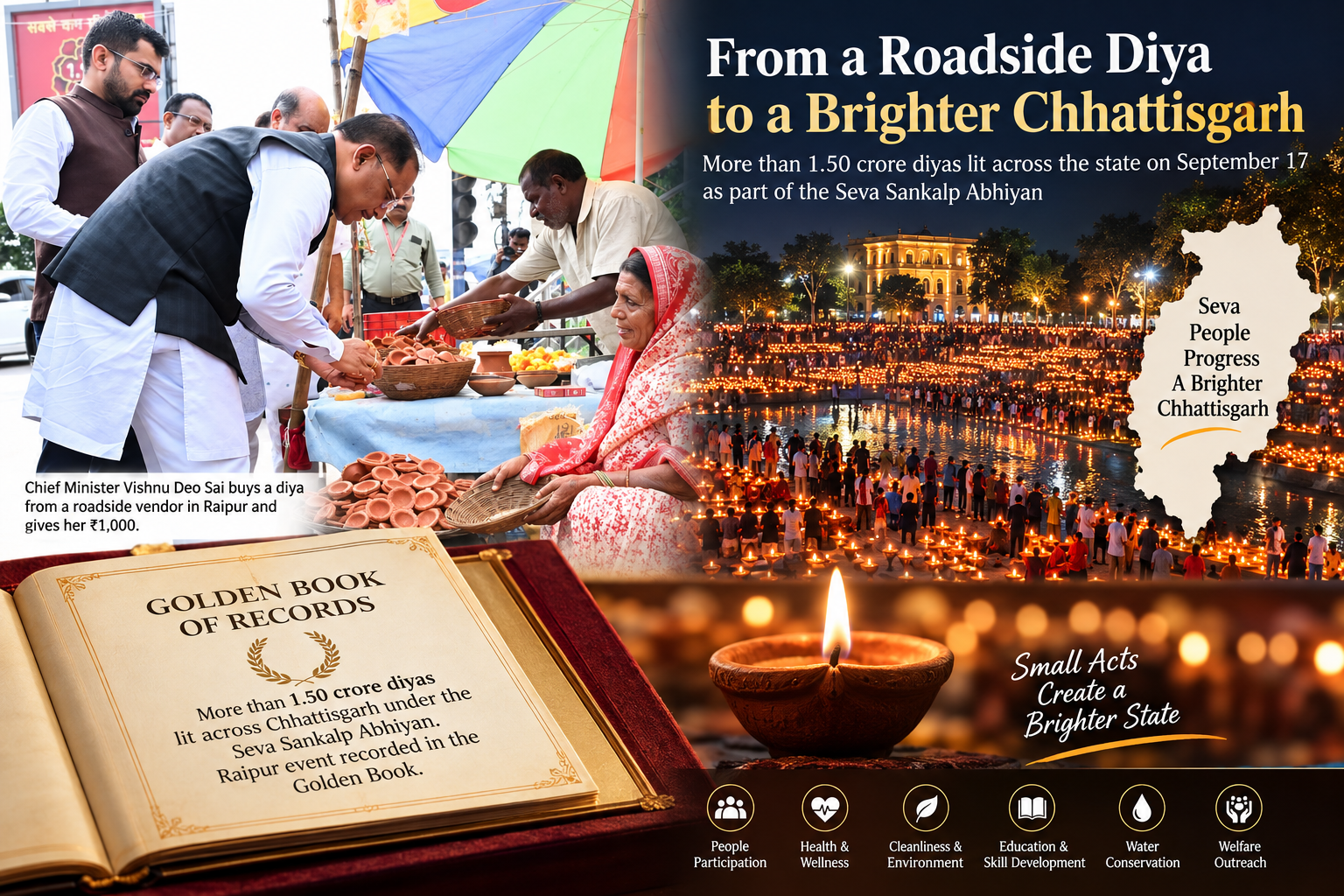
Chief Minister Vishnu Deo Sai buys an earthen diya from a roadside vendor in Raipur, an image that became associated with the wider ‘Aashirwad Ka Diya’ initiative. More than 1.50 crore diyas were reported lit across Chhattisgarh on September 17 under the Seva Sankalp Abhiyan, with the Raipur event receiving Golden Book recognition. The month-long campaign continues until October 17, 2026. Photo:channel24india.com/ Composite elements: AI-generated/Representational
Investment, healthcare, tourism, urban spaces and public participation are unfolding alongside a month-long Seva Sankalp Abhiyan that will keep Chhattisgarh engaged until October 17
Sometimes the story of a state can begin with something very small.
In Chhattisgarh this September, it could begin with an earthen lamp.
On September 15, Chief Minister Vishnu Deo Sai stopped at the roadside stall of Meera, a diya seller at Telibandha Marine Drive in Raipur. He bought a diya and gave the vendor ₹1,000. During their conversation, Meera told him that she had a bank account under the Pradhan Mantri Jan Dhan Yojana and was receiving ₹1,000 a month under the Mahtari Vandan Yojana.
Two days later, that small diya became part of something much larger.
On September 17, more than 1.50 crore ‘Aashirwad Ke Diye’ were reported to have been lit across Chhattisgarh as part of the Seva Sankalp Abhiyan. Women, students, farmers, workers and other citizens participated in programmes extending from villages to cities.
But it would be a mistake to see September 17 as the conclusion of the programme.
It was the beginning.
The Seva Sankalp Abhiyan runs from September 17 to October 17, 2026, which means Chhattisgarh still has many more days of programmes ahead. The campaign includes activities related to blood donation, health, nutrition, cleanliness, tree plantation, water conservation, education, digital literacy, welfare outreach and citizen participation. Among the programmes announced are Seva Mera Yogdan, Seva Ke Rang, Rashtra Ke Sang, Seva Sankalp Yatra, Seva Setu–Sarkar Aapke Dwar, Jal Jan Seva Sankalp, Seva First Innovation Challenge and a concluding Sushasan Seva Samvad.
So the diya should perhaps be viewed not as the story itself, but as its opening image.
Beyond the Light of the Diya
At almost the same time, another Chhattisgarh story has been taking shape—one measured not in earthen lamps but in investment, infrastructure and economic ambition.
At the Viksit Chhattisgarh Conclave 2026 in Nava Raipur, the state government presented its long-term development vision and said investment proposals exceeding ₹8.23 lakh crore had been received.
That is an extraordinary number.
But numbers in current affairs need context.
An investment proposal is not the same thing as an investment realised. Memoranda, expressions of interest and proposals acquire their true economic meaning only when factories are constructed, businesses begin operating, capital is actually deployed and employment is created.
That distinction is important, particularly for students.
Chhattisgarh possesses enormous natural-resource advantages. It is a major producer of coal, steel, minerals and electricity. The larger question is whether those advantages can increasingly be converted into manufacturing, processing, technology, entrepreneurship and sustainable employment.
That is the development story worth following—not merely how many lakh crore rupees are announced, but how much ultimately reaches the ground.
Bastar and the Battle Over Perception
Then there is Bastar.
For decades, national conversations about Bastar have frequently been dominated by Maoist violence, security operations and conflict.
The Chhattisgarh government is now attempting to place another image alongside that one: Bastar as a destination of forests, waterfalls, tribal culture, tourism and economic opportunity.
Changing perception, however, requires more than changing vocabulary.
If Bastar is to become an important tourism and investment destination, security improvements must be accompanied by roads, communications, accommodation, healthcare, skilled employment, environmental protection and—most importantly—meaningful participation by the communities who live there.
The real transformation will have occurred when people outside Chhattisgarh begin thinking about Bastar’s landscapes and culture without needing to be persuaded to forget its history.
Sirpur Can Tell Another Chhattisgarh Story
A quieter development this month came from Sirpur.
A 17-member delegation from Ehime University in Matsuyama, Japan, visited the historic town and explored sites including the Lakshman Temple and important Buddhist archaeological remains.
It may appear to be simply another academic visit, but Sirpur represents something larger.
Chhattisgarh possesses a history that is still insufficiently known outside the state. Archaeology, heritage conservation, academic exchanges and international tourism can together create an entirely different form of development—one that does not depend on extracting something from beneath the earth but on understanding and preserving what previous generations left upon it.
A mineral-rich state can also be a heritage-rich state.
Healthcare Is Becoming Part of the Development Conversation
Healthcare has also moved prominently into the state’s current-affairs landscape.
At the 4th BMC Chhattisgarh Cancer Conclave in Nava Raipur, the discussion went beyond treatment to prevention, early diagnosis and compassionate cancer care.
The state has also highlighted plans for a 5,000-bed Medicity in Nava Raipur.
Again, the number attracts attention, but numbers should be the beginning of the journalistic question rather than its conclusion.
Five thousand beds will matter when buildings, doctors, nurses, diagnostic facilities, specialists and affordable treatment come together.
A hospital is ultimately not measured by the number of beds announced.
It is measured by what happens when a frightened patient arrives at its door.
That distinction between infrastructure announced and service delivered applies across public policy.
Even ₹7.29 Crore Tells a Development Story
Against investment proposals of ₹8.23 lakh crore, ₹7.29 crore for three urban parks may appear insignificant.
It is not.
Modern parks proposed under AMRUT 2.0 in Ahiwara, Mungeli and Kanker are planned with 8,732 plants, children’s play areas, open gyms, walking paths, seating, lighting, toilets, gazebos and rainwater-harvesting facilities.
Development is experienced at different scales.
A steel plant can change a regional economy.
A hospital can save a life.
A road can connect a village.
And a well-maintained park can change the everyday experience of a neighbourhood.
Children need somewhere to play. Senior citizens need somewhere to walk. Families need public spaces that do not require an entrance ticket.
That too is development.
Chhattisgarh Has Not Finished Celebrating Yet
This is why the coming weeks deserve attention.
The lighting of the diyas on September 17 was visually spectacular, but the Seva Sankalp Abhiyan continues until October 17. Its announced calendar moves from symbolism towards a series of service and participation activities.
Between September 23 and 25, Seva Mera Yogdan is intended to encourage citizens and institutions to undertake service activities including blood donation, plantation, cleanliness, health checks, water conservation, educational assistance and digital literacy. September 29 is scheduled for Seva Ke Rang, Rashtra Ke Sang, while other programmes include government outreach camps, water-conservation activities and initiatives focusing on Bastar.
October 7 will mark another significant stage in the programme, followed eventually by its conclusion on October 17 with the proposed Sushasan Seva Samvad.
There will therefore be many more days of activity across Chhattisgarh before the campaign ends.
But there is also a useful journalistic question to carry through those days:
What remains after the celebration?
A blood-donation camp should be remembered for the blood collected.
A health camp for the people diagnosed and treated.
A plantation drive for the trees that survive.
A government outreach camp for the citizen whose unresolved problem was actually resolved.
A water-conservation programme for the water it ultimately saves.
And an investment summit for the investment that actually arrives.
From One Diya to the Larger Question
Seen together, Chhattisgarh’s September developments make an unusual current-affairs canvas.
There is the ₹1,000 handed to a roadside diya seller. There are the reported 1.50 crore lamps lit across the state. There is ₹7.29 crore for urban parks, a proposed 5,000-bed Medicity, international interest in Sirpur, a changing conversation around Bastar, and ₹8.23 lakh crore in investment proposals.
The figures could hardly be more different.
Yet they ultimately lead to the same question.
Development is not only what governments announce, nor only what critics question. It is what citizens eventually experience.
That is also why the period between September 17 and October 17 may be more revealing than a single evening illuminated by millions of diyas.
The lamps provided a powerful opening image.
What Chhattisgarh does in the days that follow—and what remains when the celebrations end—will tell the more important story.
— Kumar Bahukhandi
Journalist, Editor and Assistant Professor of Journalism & Mass Communication