Kumar Bahukhandi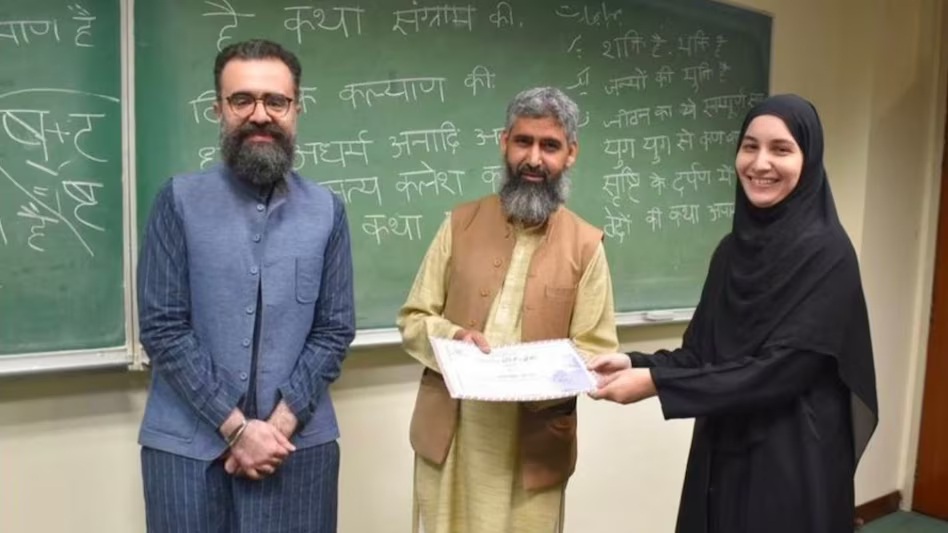
Two Sanskrit teachers with a student at LUMS. (Photo:X/The tribune)
Pakistani professor Shahid Rashid, who has studied Sanskrit himself, said, “Why shouldn’t we learn it? It’s a language that connects the entire region.” He noted that the village of Sanskrit grammarian Panini was in this area. Much writing was done here during the Indus Valley Civilization. He said that within the next few years, Pakistan will have its own Sanskrit scholars.
Sanskrit verses are being recited in Pakistani college classrooms. Students are being taught the Urdu translation of the title song “Hai Katha Sangram Ki,” from the popular Indian television series Mahabharata. Lahore University of Management Sciences (LUMS) has introduced Sanskrit teaching for the first time since Pakistan’s formation.
Dr. Ali Usman Qasmi, director of the Gurmani Center, explained that the Punjab University Library in Pakistan houses the richest collection of Sanskrit documents. However, no Pakistani academic has consulted this collection since 1947. Only foreign researchers use it. He said things are about to change. Pakistan will now train local scholars in Sanskrit, allowing Pakistanis to utilize this Sanskrit heritage.
According to a report in The Tribune, Shahid Rashid, associate professor of sociology at Forman Christian College, is at the center of reviving Sanskrit studies in Pakistan. He described the launch of this course as “a small but significant step toward reviving the serious study of a language that has shaped philosophy, literature, and spiritual traditions across the region.”
According to LUMS, Rashid’s long-standing passion for Sanskrit led him to study the language alone for years.
Shahid Rashid has studied Sanskrit himself. Rashid told the Tribune, “I tell them, ‘Why shouldn’t we learn it? It’s a language that connects the entire region.’ Sanskrit grammarian Panini’s village was in this area. Much writing was done here during the Indus Valley Civilization. Sanskrit is like a mountain—a cultural monument. We have to embrace it. It belongs to us too; it’s not tied to any particular religion.”
Gurmani Center Director Ali Usman Qasmi told the Tribune that initially, a weekend program was offered, open to everyone, including students, researchers, lawyers, and academics.
Qasmi said, “After seeing the response, we decided to launch it as a proper university course. Although the number of students is still low, we hope it will grow in the next few years. Ideally, by the spring of 2027, we will be able to teach the language as a year-long course.”
LUMS is also planning to start courses on the Mahabharata and the Bhagavad Gita. Dr. Qasmi says, “Hopefully, this will create momentum. In 10-15 years, we could see scholars of the Gita and Mahabharata living in Pakistan.”
Dr. Rashid took leave from FC College to teach the course at LUMS. He says, “I mostly teach grammar. When I was teaching the ‘Subhashit,’ meaning verses of wisdom, many of my students were surprised to learn that so many Urdu words came from Sanskrit. Many didn’t even know that Sanskrit was different from Hindi. They found it a difficult language for the first week. But once they understood its logical structure, they began to enjoy it.”
Dr. Qasmi explains that this initiative is also connected to the university’s large language ecosystem, which includes Sindhi, Pashto, Punjabi, Balochi, Arabic, and Persian. “We understand the importance of connecting with this glorious tradition, which is part of the Pakistani-Indian global heritage. Much of our literature, poetry, art, and philosophy dates back to the Vedic era.