Kumar Bahukhandi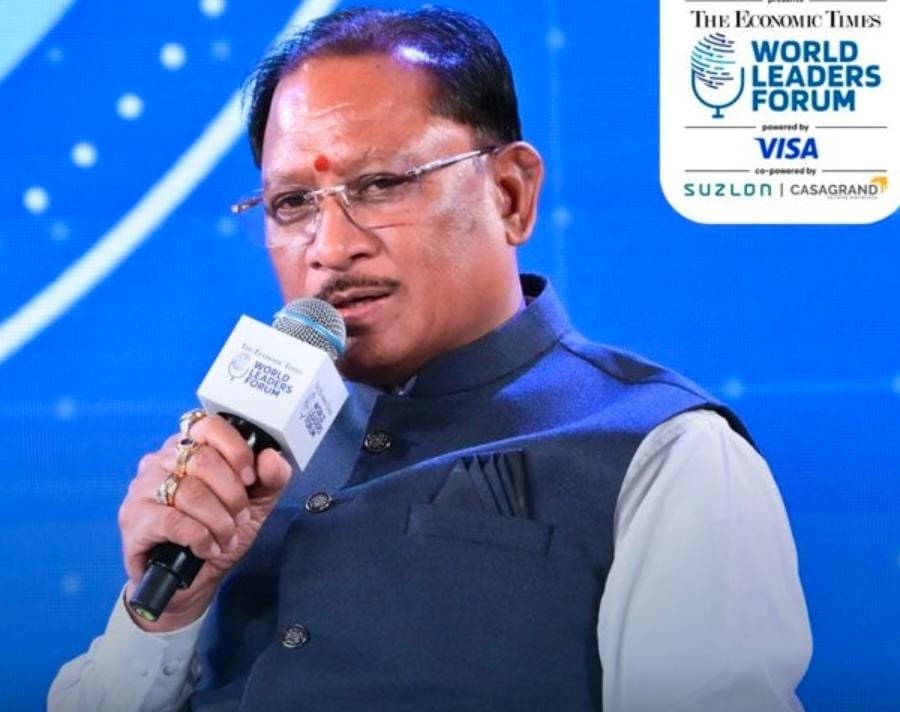
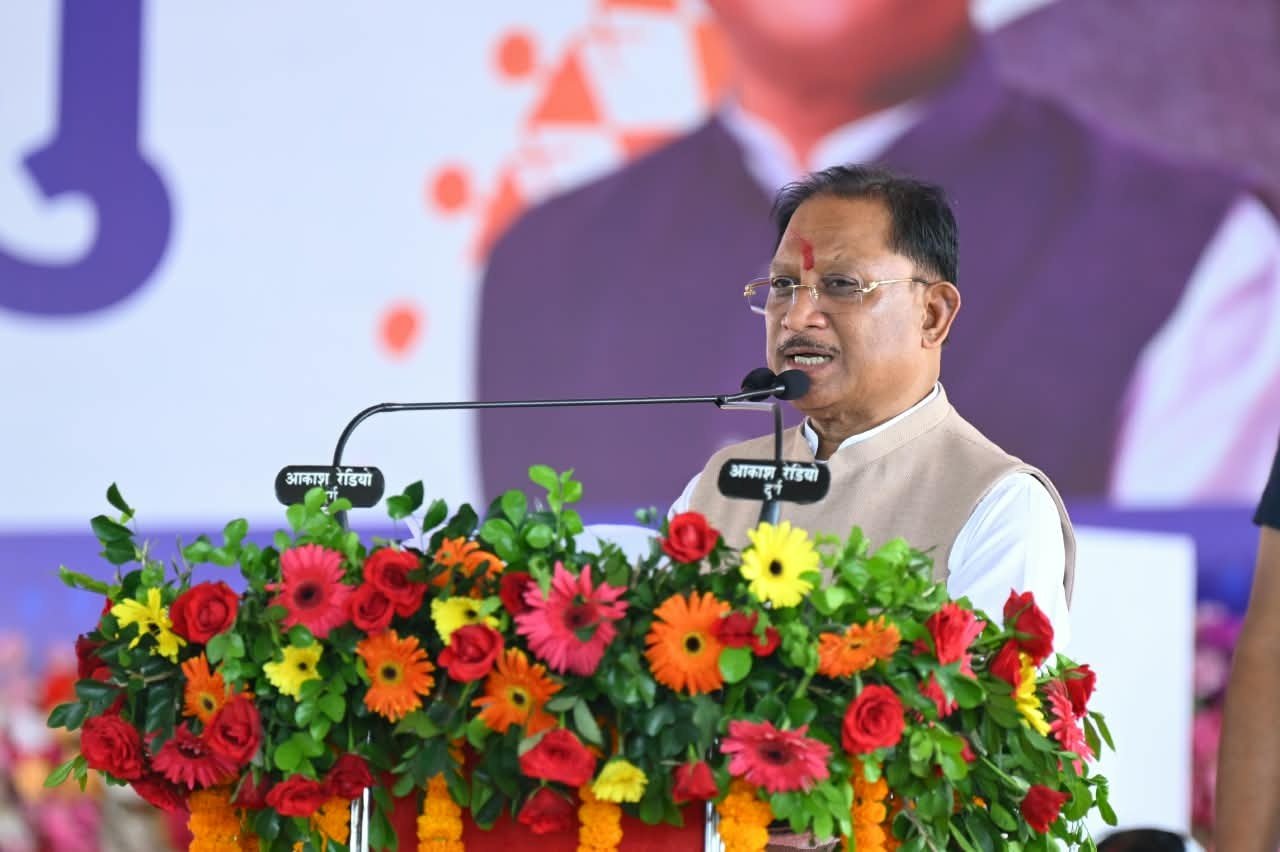
Chhattisgarh Chief Minister Vishnu Deo Sai addresses the Economic Times World Leaders Forum in New Delhi on Friday, August 21, 2026, presenting the state’s investment and growth vision centred on youth entrepreneurship, artificial intelligence, startups and emerging industries-Photo Credit”channel24india.com via CG/DPR
From AI and startups to Bastar and green energy, Chief Minister tells a high-profile global forum that investment must ultimately translate into jobs, entrepreneurship and higher incomes for Chhattisgarh’s people
Key Highlights
- “Our youth should not merely remain job seekers; they must become job creators,” says Sai
- Chhattisgarh’s growth vision presented alongside prominent Indian and international political and business leaders
- S Jaishankar, Boris Johnson and US Ambassador Sergio Gor among prominent speakers listed for the forum
- “Investment must be connected with employment, entrepreneurship and better incomes”
- State targets 5,000 startups by 2030
- Six lakh students and 1.5 lakh government employees proposed to receive AI training
- More than ₹8 lakh crore in investment proposals received following the new industrial policy
- ₹500-crore State AI Mission envisages 100 AI data labs and five Centres of Excellence
- Sai projects a changing Bastar as a new frontier for tourism, investment and employment
- “Chhattisgarh should not remain merely a producer of raw materials”
New Delhi: Chhattisgarh Chief Minister Vishnu Deo Sai on Friday, August 21, 2026, placed the state’s emerging economic ambitions before a high-profile national and international audience, declaring that the ultimate purpose of investment must be to create entrepreneurs, jobs and better incomes — particularly for young people.
Addressing the two-day Economic Times World Leaders Forum in New Delhi, Sai sought to redefine Chhattisgarh’s economic identity beyond its traditional strengths in minerals, steel, cement and power.
His central message was directed at the state’s youth.
“We want the youth of Chhattisgarh not merely to remain job seekers, but to become job creators through their innovation and entrepreneurship,” Sai said.
It was more than a slogan in Sai’s presentation. The Chief Minister linked the idea to a broader economic roadmap encompassing startups, artificial intelligence, semiconductors, electronics, data centres, pharmaceuticals, green energy, advanced manufacturing and greater value addition within Chhattisgarh.
Sai also made clear that investment figures alone would not define the success of his government’s industrial strategy.
“Our goal is not only to bring major investment to Chhattisgarh, but to connect investment with employment, entrepreneurship, better incomes and a brighter future for our youth,” he said.
The setting gave that message wider significance.
Sai’s participation placed Chhattisgarh’s investment and growth agenda before a forum featuring prominent political, corporate, investment and technology leaders from India and abroad.
Among those listed as speakers at the 2026 World Leaders Forum are External Affairs Minister S Jaishankar, former British Prime Minister Boris Johnson and US Ambassador to India Sergio Gor.
The chief ministerial line-up includes Maharashtra Chief Minister Devendra Fadnavis, Madhya Pradesh Chief Minister Mohan Yadav, Uttarakhand Chief Minister Pushkar Singh Dhami and Bihar Chief Minister Samrat Choudhary.
The business and international roster includes Aditya Birla Group Chairman Kumar Mangalam Birla, Google Cloud Asia-Pacific President Karan Bajwa, Marriott International President and CEO Anthony Capuano, Boston Consulting Group CEO Christoph Schweizer, J.P. Morgan Global Chair of Investment Banking Anu Aiyengar, Sun Life President and CEO Kevin Strain, and Dubai Chambers President and CEO Mohammad Ali Rashed Lootah, among other business leaders.
Against this backdrop, Sai presented Chhattisgarh not simply as a resource-rich state seeking capital, but as one attempting to use investment to make a transition towards a technology- and entrepreneurship-driven economy.
From AI and Startups to Bastar — Sai Defines the Next Growth Phase
A major pillar of that transition is entrepreneurship.
Chhattisgarh has set a target of developing 5,000 startups by 2030, while new entrepreneurs are being offered seed-fund assistance of up to ₹10 lakh to help turn innovative ideas into businesses.
The proposition is straightforward: if more young people can establish viable enterprises, investment creates not only individual businesses but a wider cycle of local employment.
Artificial intelligence occupies an equally prominent place in Sai’s roadmap.
The state plans to provide AI training to six lakh students and 1.5 lakh government employees, while more than 50 AI-based government services are proposed.
Sai, however, sought to place AI beyond the language of technology alone.
“AI is not merely about technological change. Its real purpose is to improve the quality of education, prepare young people for future employment and entrepreneurship, and make government services more effective and citizen-centric,” the Chief Minister said.
The proposed ₹500-crore State AI Mission envisages 100 AI data laboratories, five Centres of Excellence and support for more than 300 AI startups.
Nava Raipur is also proposed to host an AI Data Centre Park involving investment of around ₹1,000 crore, potentially strengthening Chhattisgarh’s position in India’s expanding digital infrastructure ecosystem.
Sai backed his pitch with the scale of investment interest received by the state.
According to the Chief Minister, Chhattisgarh has attracted more than ₹8 lakh crore in investment proposals since the Industrial Development Policy 2024-30 came into effect.
The government says more than 450 procedures have been simplified over the past two years. The One Click Single Window System 2.0 and Ease of Doing Business reforms are intended to make approvals simpler and more time-bound.
The Ease of Doing Business Act, 2026 introduces deemed approvals in specified low-risk cases where decisions are not taken within the prescribed period. Forty-three services of eight departments have been brought within the framework, potentially affecting around 15 lakh MSMEs.
Sai also presented a picture of a growing state economy.
Chhattisgarh’s economy reached approximately ₹6.31 lakh crore in 2025-26, according to figures presented by the Chief Minister, with growth of 11.57 per cent and per-capita income of ₹1,79,244.
The ₹1.72-lakh-crore state Budget for 2026-27 places emphasis on infrastructure, capital expenditure and welfare alongside roads, rail connectivity, energy and digital and industrial infrastructure.
Yet one of Sai’s most significant messages concerned a region historically viewed through an entirely different lens — Bastar.
“The changing Bastar is one of the most important chapters in Chhattisgarh’s development journey,” Sai said.
With security conditions improving, the government is attempting to reposition Bastar from a region associated predominantly with Maoist violence to one increasingly connected with tourism, livelihoods, investment and enterprise.
A ₹4,824-crore livelihood enhancement programme is being prepared with the objective of raising incomes of nearly 10 lakh families in Bastar and elsewhere in the state.
Sai also cited the reopening of 421 previously closed schools and the creation of digital health profiles for more than 34 lakh people as indicators of the expansion of government services.
Connectivity could be crucial to the next stage.
The proposed ₹3,513-crore Jagdalpur-Raoghat railway project is expected to improve Bastar’s industrial and commercial links and provide local products with better access to larger markets.
Sai also sees tourism as an economic opportunity.
Chitrakote, Tirathgarh and Kanger Valley, together with Bastar’s distinctive tribal culture, are being positioned within a wider tourism strategy. With tourism accorded industry status, the government expects opportunities for private investment in hospitality, hotels, transport and associated services.
But Sai’s economic argument for Bastar — and indeed for the entire state — goes deeper than extracting more natural resources.
It centres on value addition.
“Our objective is that Chhattisgarh should not remain merely a producer of raw materials. Products should be manufactured here and the maximum economic value should reach local people,” Sai said.
That statement perhaps most clearly defines the economic transition the Chief Minister sought to present at the forum.
Chhattisgarh possesses substantial mineral and energy resources, but processing those resources and manufacturing higher-value products within the state could potentially retain a larger share of investment, employment and income locally.
Electronics manufacturing infrastructure is being developed in Nava Raipur and Rajnandgaon. Plans also include a space-manufacturing cluster in Rajnandgaon, a 142-acre pharma park and textile and readymade-garment facilities.
The discovery of lithium in Korba has added another possible dimension, with opportunities potentially emerging in batteries, energy storage and new-energy industries.
Sai also linked Chhattisgarh’s next phase of industrialisation with the energy transition.
The state plans to add around 4,000 MW of solar capacity in the coming years. More than 90,000 homes have been connected with solar energy, while the state’s first floating solar plant has been established in Bhilai.
For a state traditionally identified as a major conventional-energy producer, the shift towards renewables could create both a new investment sector and a new category of green employment.
Taken together, Sai’s presentation at the World Leaders Forum offered a different formulation of the Chhattisgarh growth story.
Minerals, steel, cement and power remain its industrial foundation. But the Chief Minister’s pitch was that AI, startups, advanced manufacturing, renewable energy, value addition and young entrepreneurs should increasingly determine what comes next.
And running through virtually every element of that presentation was one recurring test: whether investment ultimately changes people’s economic opportunities.
That brings the argument back to where Sai began — Chhattisgarh’s youth.
If the state’s ₹8 lakh crore-plus investment proposals, startup targets, AI infrastructure and emerging industries translate from commitments into functioning enterprises and sustainable employment, the shift from “job seeker” to “job creator” could become more than the defining phrase of Sai’s World Leaders Forum address.
It could become the measure by which Chhattisgarh’s proposed economic transformation is judged.
Sai concluded by inviting global investors to participate in the state’s next phase of development, projecting Chhattisgarh as a combination of natural resources, energy availability, young human capital, improving connectivity, modern infrastructure and increasingly investment-oriented policies.
Chief Minister’s Adviser R Krishna Das, Principal Secretary to the Chief Minister Subodh Kumar Singh, Secretaries to the Chief Minister P Dayanand and Rahul Bhagat, Special Secretary and Public Relations Commissioner Rajat Bansal, Resident Commissioner Shruti Singh and other officials were present.