Kumar Bahukhandi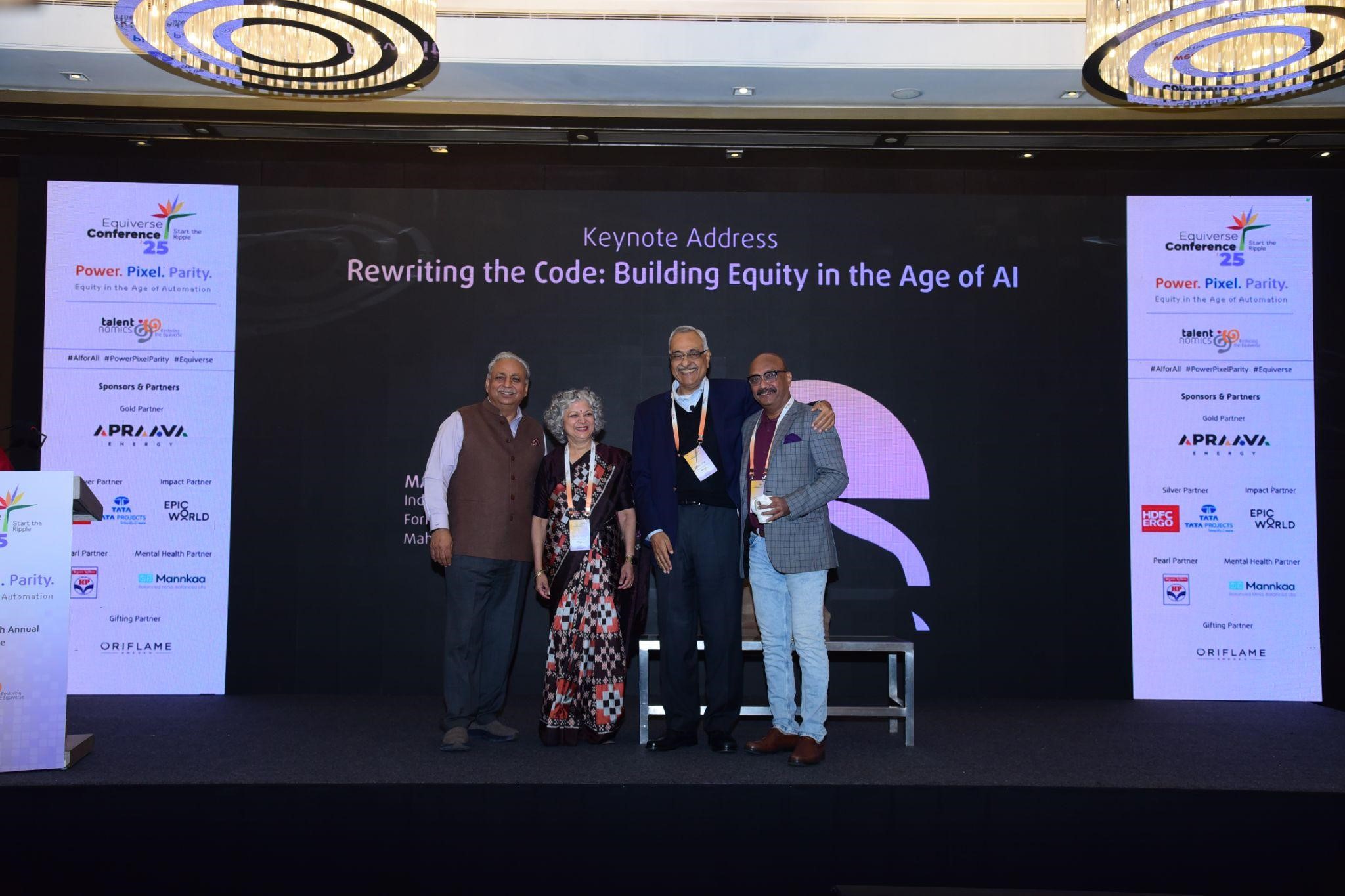
The rapid acceleration of Artificial Intelligence (AI) poses the most significant challenge yet to gender equity in the workforce and wealth creation. This was the central focus at the TalentNomics India’s 10th Annual Conference, ‘Power. Pixel. Parity.,’ where top corporate leaders, investors, and innovators gathered to move beyond fear to build a proactive roadmap for Responsible AI and gender equity in India’s future of work, wealth and wellbeing.
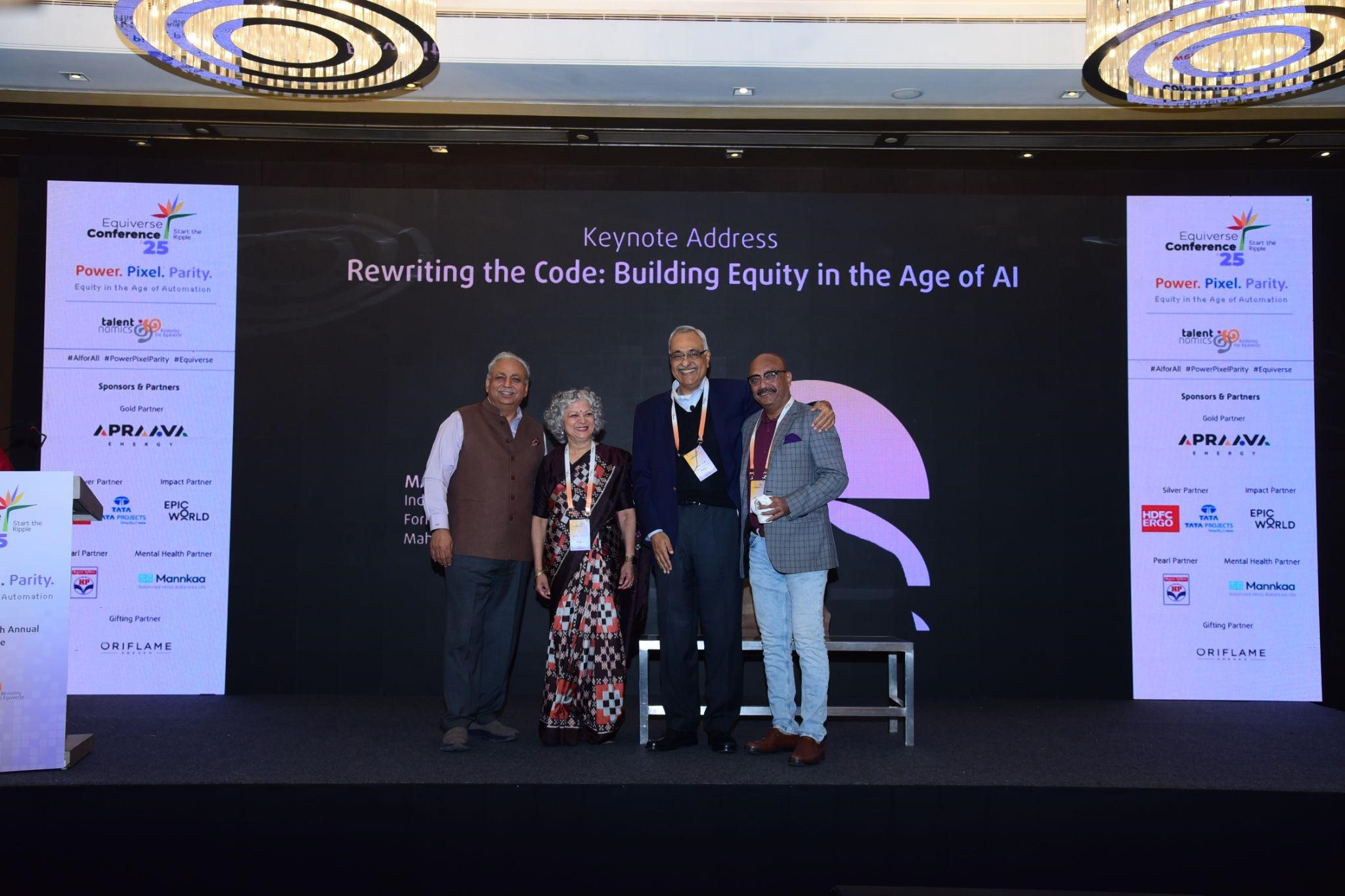 |
CP Gurnani, Manoj Chugh, & Jagdish Mitra joined Ipsita Kathuria at the 10th Annual TalentNomics Conference: Equity in the Age of Automation
The day was anchored by powerful insights from three of India’s most respected leaders:
-
CP Gurnani underscored that the path to AI equity requires deliberate, ethical design. “What can we do to keep our power of curiosity, our power of creative thinking, our power of learning and applying data in our everyday life. Because to me AI is all about training the data, and if AI is all about training the data, then I need to pick up instances where I can power it.”
-
The pivotal question from industry veteran Manoj Chugh served as a call to action: “Are we interrupting the bias? If not, we are not doing good.” The core message was that since AI learns from historical, often biased, data, the responsibility lies with human leaders to interrupt these patterns through sponsorship and intentional design.
-
Suparna Mitra highlighted the necessity of intentional gender equity strategies in leadership and consumption. “At the Talentnomics India 10th Annual conference, I had the privilege of addressing the good people who had gathered to discuss how the AI revolution will impact gender dynamics. Whenever a new technology comes, the existing norms get re-shaped. The AI revolution does not just belong to the people who work on the technology, but all of those who use the technology. The moral and ethical dimensions need to be examined for us to ensure that the gender gap is balanced, rather than get worsened.”
The Future of Work & The Disruption of Income
The session, ‘Work Rebooted – Breaking the Digital Ceiling,’ moderated by Lata Singh, dissected the differential impact of AI on the workforce, highlighting the urgent need for task-level reskilling.
-
Task-Level Disruption: Jagdish Mitra emphasized that AI disruption occurs at the task level, not just the role level. He noted that while women make up 35% of the IT workforce, nearly 70% of their roles are task-heavy and highly exposed to automation. His guidance: HR teams must champion diversity, and individuals must perform a task-based analysis of their job to identify what to reskill for.
-
The Investment Risk of Inequity: Dr. Archana Hingorani connected workforce gender equity to the balance sheet. She argued that ignoring the displacement of women creates systemic market instability and limits the available talent pool, making ignoring gender equity a bad business decision for the investor.
-
Owning the AI Ecosystem: Shalaka Verma outlined the three key opportunity domains: Builders of AI, Maintainers of AI, and Users of AI, urging women to seize the early-mover advantage in this transition and actively define their space before others define it for them.
The Infrastructure of Wealth & Wellbeing
These panels addressed how AI impacts the fundamental structures of wealth creation and care, from investments to healthcare access.
-
Code to Capital: Reducing the Wealth Gap: The deeply insightful session on the gender wealth gap, led by Soumya Rajan and Anita George, concluded that the gap stems from structural issues and behavioral biases. They affirmed that AI is a powerful ‘copilot’ capable of de-biasing financial planning and nudging women from mere savers to active investors. Anita George stressed that “Investing is self-care” and emphasized the need for trust, governance, and security in the financial sector to ensure women become true capital creators.
-
Rebalancing Care & Rural Healthcare: The sessions highlighted that both urban and rural women face unique barriers to wellbeing. Partha Dey showcased how the shift of services from hospital to home significantly improves access for women. Furthermore, the session on “Beyond the Grid: AI and the Future of Rural Healthcare” with Jyotsna Krishnan & Priyadarshi Mohaparta highlighted how a hybrid “phygital” model using Community Champions (primarily women) can be the viable solution for India’s large rural market, ensuring the entire loop of diagnostics and medicine is closed and reducing time burdens for women caregivers.
-
The Human Heart of Empathy: Dr. Dev Brar addressed the limits of AI in mental health, noting: “AI heard my words, but not my silence.” Bhavana Issar also emphasised that while AI can enable wellbeing, it cannot replace the Human touch. Shilpa Ajwani concluded that Human and technical review must go hand in hand to ensure AI works for everyone.
Governance and Guardrails: The Mandate for Equitable AI
The consensus across the conference was that AI is not inherently biased, but rather amplifies the bias already present in the human data it learns from, necessitating strong guardrails.
-
Bias Amplification: The session on ‘Unbiased by Design’ concluded that AI models are inherently prone to perpetuating historical human biases because they learn from flawed data, making simply removing gender labels insufficient. The core consensus of the panel, featuring Kiran Chhabra, Renu Menon, Uma Rani, and Arjun Venkatraman, captured by the motto “Nothing About Us Without Us,” is that achieving equitable AI requires active, sustained oversight.
-
Policy and Accountability: This includes enforcing mandatory AI audits and governance frameworks to ensure equal error rates across demographic groups, and critically, involving women and underrepresented groups as data stewards to reduce bias at the source of data collection and annotation. As observed by L Venkata Subramanian and Aneesh Patnaik, we need technological solutions, diverse policy input, and active user feedback.
-
Societal Movement: Sunaina Kumar emphasized that patriarchal structures are mirrored in digital spaces, and without robust governance, AI risks weakening women’s economic security. Ratnesh Jha concluded that fixing this requires a societal “movement,” stressing that companies must be held accountable by consumers, and organizations must commit to not allowing bias in their own systemic decisions.
Conclusion: Sponsorship and Concrete Action
The conference underscored that fixing the future starts with fixing the present. The most potent advice from the floor was the need to move from mentorship to sponsorship. Sponsorship is the action—the advocacy and the intentional door-opening—that ensures women are in the rooms where AI decisions are being shaped.
Neeta Boochra, member of the TalentNomics Advisory Board, rekindled the room’s momentum with her vote of thanks, reinforcing that influence must translate into opportunity and conversation into measurable change. The conference’s success lay in its commitment to translating high-level dialogue into concrete, actionable steps toward a gender-equitable Digital future.
About TalentNomics India
TalentNomics India is a non-profit organisation working to create a world where gender equity is the norm. Since 2016, the organisation has operated leadership development programs for women and convened annual conferences featuring multi-stakeholder dialogues on barriers to equity in work, wealth, wellbeing, and welfare. Through research, advocacy, and collaboration with corporate, government, and civil society partners, TalentNomics India advances systemic approaches to gender equity.
Website: www.india.talentnomics.org
Instagram: www.instagram.com/talentnomicsindia/
LinkedIn: in.linkedin.com/company/talentnomicsindia