Kumar Bahukhandi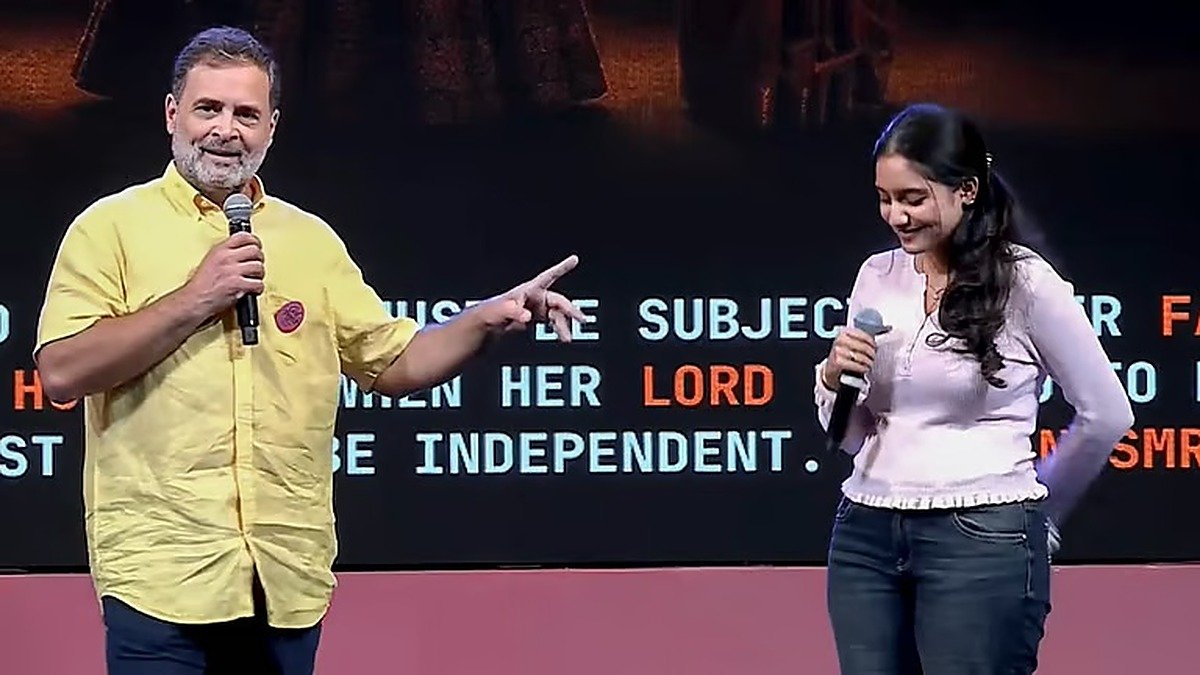
Leader of the Opposition in the Lok Sabha Rahul Gandhi addresses the women-focused ‘Chhatron Ki Goonj’ programme in Pune on Saturday, August 22, 2026, where he criticised the Manusmriti’s prescription on women’s independence and urged women to assert their own identity and autonomy. (Photo: PTI)
The Congress leader’s message of women’s autonomy deserves support. Yet his criticism of Manusmriti raises a larger question: should an ancient and contested text be judged through one verse without confronting other passages within the same work that command society to honour women?
Key Highlights
- Rahul Gandhi told women in Pune that they belong to themselves, not to their fathers, husbands or sons.
- The Manusmriti passage at the centre of the controversy is genuine: Chapter 9, Verse 3 places a woman under the protection of male family members at different stages of life.
- Yet Manusmriti 3.56 also declares: “Where women are honoured, there the gods rejoice.”
- The widely quoted “Karyeshu Mantri, Karaneshu Dasi…” presents an idealised wife as counsellor, caregiver and companion, but its attribution to Manusmriti is uncertain.
- The real debate is therefore not whether women deserve autonomy—they unquestionably do—but whether an ancient text can fairly be understood through one passage without examining its wider context.
Congress leader and Leader of the Opposition in the Lok Sabha Rahul Gandhi delivered a message to young women that deserves to travel beyond the boundaries of party politics: a woman belongs to herself on Saturday August22 in Pune .
Addressing the women-only edition of the ‘Chhatron Ki Goonj’ programme in Pune, Gandhi challenged the idea that a woman’s identity should pass successively from her father to her husband and eventually to her sons.
His central proposition is difficult to dispute in a modern constitutional democracy.
A woman is not somebody’s possession. She has an identity independent of being a daughter, wife or mother. Her education, career, ambitions, political choices and personal dignity belong to her.
On that principle, Rahul Gandhi’s message deserves appreciation rather than partisan dismissal.
The more interesting question begins where Gandhi brought the Manusmriti into his argument.
The passage underlying that argument is not imaginary. Manusmriti 9.3 reads:
पिता रक्षति कौमारे भर्ता रक्षति यौवने।
रक्षन्ति स्थविरे पुत्रा न स्त्री स्वातन्त्र्यमर्हति॥
Pitā rakṣati kaumāre bhartā rakṣati yauvane,
Rakṣanti sthavire putrā na strī svātantryam arhati.
Broadly translated, it says that the father protects a woman in childhood, the husband in youth and the sons in old age, concluding with the much-debated proposition that a woman should not be independent.
Read through twenty-first-century ideas of individual liberty, the final expression — “न स्त्री स्वातन्त्र्यमर्हति” (na strī svātantryam arhati) — is plainly difficult to reconcile with the equality and autonomy Indian women possess under the Constitution.
Rahul Gandhi therefore has a textual basis for questioning this conception of women’s independence.
But does this one verse settle everything Manusmriti says about women?
One Verse Cannot Tell the Whole Story
This is where political rhetoric ought to make room for scholarship.
Elsewhere, in Chapter 3, Verse 56, Manusmriti makes another extraordinarily well-known declaration:
यत्र नार्यस्तु पूज्यन्ते रमन्ते तत्र देवताः।
यत्रैतास्तु न पूज्यन्ते सर्वास्तत्राफलाः क्रियाः॥
Yatra nāryastu pūjyante ramante tatra devatāḥ,
Yatraitāstu na pūjyante sarvāstatrāphalāḥ kriyāḥ.
Its meaning is striking: Where women are honoured, there the gods rejoice; where they are not honoured, all acts become fruitless.
The verses around it similarly associate the happiness and honour of women with the welfare of the family.
So what are we to make of a text that, in one passage, limits a woman’s independence according to the social structure of its age and, in another, declares her honour so important that even divine favour is associated with it?
That contradiction—or, at least, tension—is precisely why an ancient text cannot responsibly be reduced to a political slogan.
There is an important distinction here.
Honouring women is not necessarily the same as giving women autonomy.
An ancient social system could regard women as deserving extraordinary respect and protection while simultaneously believing that fathers, husbands and sons bore responsibility for them. A modern constitutional democracy approaches the question differently: an adult woman possesses equality and agency in her own right.
We are therefore perfectly entitled to reject an ancient restriction that conflicts with modern equality.
But rejecting that restriction does not require us to pretend that the same text contains nothing except hostility towards women.
Simply quoting “यत्र नार्यस्तु पूज्यन्ते” to prove that Manusmriti was entirely favourable to women would be incomplete.
Equally, quoting only “न स्त्री स्वातन्त्र्यमर्हति” and allowing it to represent everything the text says about women would also be incomplete.
That is the difference between reading a text and using a text.
Another Sanskrit verse frequently enters discussions about the traditional conception of the wife:
कार्येषु मन्त्री करणेषु दासी
भोज्येषु माता शयनेषु रम्भा।
धर्मानुकूला क्षमया धरित्री
भार्या च षाड्गुण्यवतीह दुर्लभा॥
Kāryeṣu mantrī karaṇeṣu dāsī,
Bhojyeṣu mātā śayaneṣu rambhā;
Dharmānukūlā kṣamayā dharitrī,
Bhāryā ca ṣāḍguṇyavatīha durlabhā.
The verse presents an idealised wife in six different dimensions: as a mantrī — counsellor or adviser — in important affairs, devoted in performing duties, nurturing like a mother in matters of food, an intimate companion, supportive in dharma and patient like the earth.
The expression “कार्येषु मन्त्री” — Karyeshu Mantri is particularly noteworthy. The wife is imagined not merely as somebody who follows instructions, but as a counsellor in matters and decisions.
At the same time, the expression “करणेषु दासी” reflects a conception of marital duty that a modern reader may legitimately question. Ancient literature should not be sanitised merely because we wish to defend tradition.
There is, however, an essential scholarly caution.
This popular verse is frequently quoted as an ancient description of an ideal wife, but its precise textual origin and attribution are uncertain. There is insufficient basis to present it confidently as a Manusmriti verse.
That distinction actually reinforces the central point of this debate: before accepting or rejecting an ancient text, we should first establish what that text actually says.
The question for Rahul Gandhi should therefore not be framed mockingly as: “Has Rahul Gandhi read Manusmriti?”
We do not know how extensively he has read it, and without evidence such a charge would be speculation.
The more legitimate question is:
Can Manusmriti—or any ancient work containing hundreds of verses composed within a social world vastly different from ours—be fairly characterised through a single verse?
And there is an even larger question for all sides of the political debate:
Have we ourselves read enough of Manusmriti to distinguish between what it actually says, what later tradition attributes to it and what contemporary politics says it says?
Rahul Gandhi’s larger message remains valuable.
India’s women belong to themselves.
Their constitutional freedom does not depend upon an ancient lawgiver, religious authority, political organisation, husband, father, son—or even a modern politician.
A woman’s dignity derives from her humanity, while her equality and individual freedom are protected by India’s constitutional order.
But precisely because that proposition is so powerful, history does not need to be simplified in order to defend it.
India should be intellectually mature enough to do two things simultaneously: reject ancient prescriptions that conflict with contemporary equality and read its civilisation honestly enough to acknowledge what its texts say in their entirety.
Neither reverence without reading nor rejection without reading constitutes scholarship.
Rahul Gandhi has opened a worthwhile conversation.
Perhaps its best outcome would not be another political quarrel over Manu.
It might instead encourage something considerably more valuable:
Before politicians quote Manu, defend Manu or condemn Manu, perhaps Indians should first read Manu.