Kumar Bahukhandi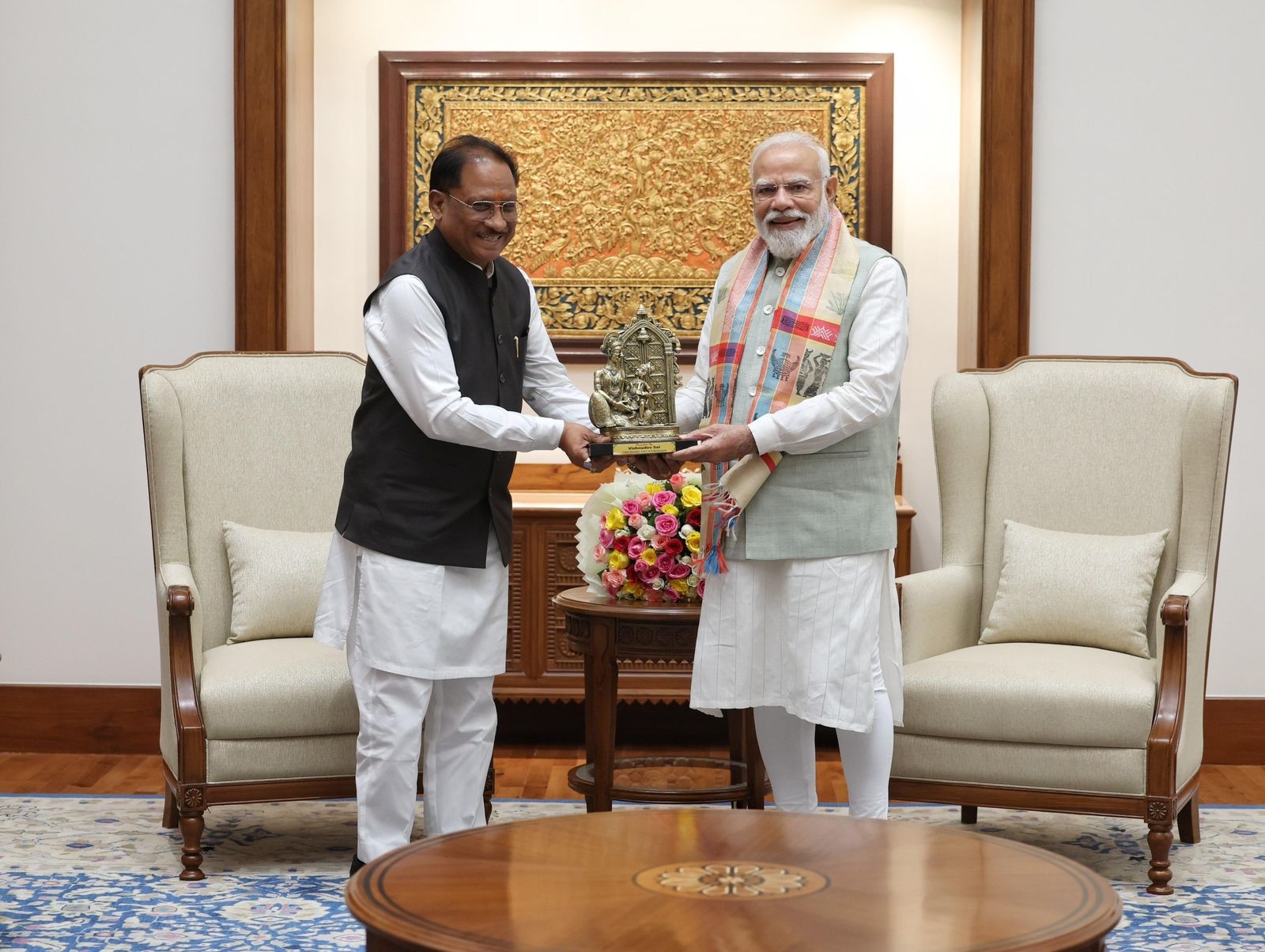
Chhattisgarh Chief Minister Vishnu Deo Sai meets Prime Minister Narendra Modi on Tuesday April 7, 2026 , presenting him a artistic pieces from Chhattisgarh-Photo Credit -CG/PR
IN Short
- A 360° Plan for Bastar: Focus on Tourism, Startups, Infrastructure, and Innovation
- PM’s Visit to Bastar Set to Be a Turning Point; Major Projects on the Horizon
New Delhi: Chhattisgarh Chief Minister Vishnu Deo Sai met with Prime Minister Narendra Modi on Tuesday April 7, 2026 , presenting a new vision for the future of Bastar.
During this meeting, the Chief Minister not only expressed his gratitude to the Prime Minister for the peace that has returned to the state following the end of Naxalism but also submitted a detailed and forward-looking blueprint for the holistic development of Bastar. Furthermore, he extended an invitation to the Prime Minister to visit Bastar after the monsoon season, where the foundation stones for several major projects—as well as the inauguration of others—are proposed to take place in his presence.
He highlighted that Naxalism has been eradicated across the entire state, including Bastar, and that peace has now been firmly established. As part of reforms in education and healthcare, new ‘Education Cities,’ super-specialty hospitals, and medical colleges are being constructed, while connectivity is being significantly bolstered through the construction of a barrage on the Indravati River, new railway lines, and airport expansion projects, CM Sai explained.
The Chief Minister stated that, through this blueprint, a new era of development, employment opportunities, and improved amenities is set to begin in Bastar, Sai added.
In his development document, the Chief Minister noted that the dream of peace and development for Bastar—envisioned by the Prime Minister a decade ago—is now becoming a reality on the ground. With the elimination of Naxalism, fear has given way to a newfound radiance of hope and progress among the people. He affirmed that under the Prime Minister’s guidance, Bastar will gain a new direction and momentum, thereby fostering increased confidence and enthusiasm throughout the region, the CM affirmed.
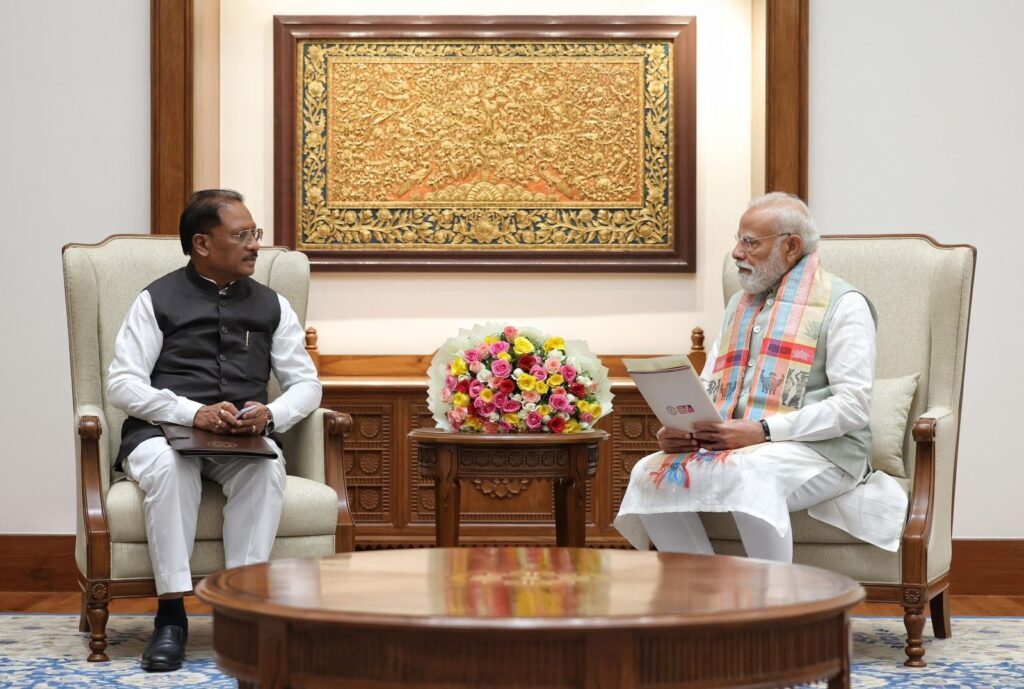
Chhattisgarh Chief Minister Vishnu Deo Sai explaining the development work carried out in Bastatr region to the Prime Minister Narendra Modi and presenting a new vision for the development of the Bastar region in New Delhi on Tuesday April 7 , 2026 -Photo Credit CG/PR
The development blueprint presented by the Chief Minister is anchored in the strategy of ‘Saturate, Connect, Facilitate, Empower, and Engage.’ Under this framework, the primary objective is to rapidly expand basic infrastructure and amenities across Bastar. Remote villages are set to be integrated into the mainstream through the development of an extensive network of roads.
In addition to completing the pending works under the Pradhan Mantri Gram Sadak Yojana by 2027, the construction of 228 new roads and 267 bridges has been proposed. Furthermore, a request for special central assistance has been made for 61 new projects.
Major transformations are also planned in the energy and infrastructure sectors. Efforts to provide electricity to every household will be accelerated. In the education sector, 45 ‘Pota Cabin’ schools will be converted into permanent buildings. For the youth, 15 stadiums and 2 multi-purpose halls will be constructed, while Primary Health Centers are being expanded—and transit hostels for doctors are being built—to strengthen healthcare services.
In the fields of agriculture and irrigation, two major projects have been sanctioned on the Indravati River at Deurgaon and Matnar, which will provide irrigation facilities to 31,840 hectares of land. These projects will play a pivotal role in strengthening the agricultural economy of Bastar.
To enhance livelihoods and income, the government has formulated a three-year plan aimed at increasing the monthly income of 85% of households from ₹15,000 to ₹30,000 by 2029. Under the ‘Niyad Nella Nar 2.0’ scheme, additional districts are now being included to ensure that the benefits of development reach a wider population.
Originally launched in 10 districts, this scheme is now being expanded to cover 7 existing districts as well as 3 new districts (Gariaband, Mohla-Manpur-Ambagarh Chowki, and Khairagarh-Chhuikhadan-Gandai), CM Sai added.
A Startup Policy has also been implemented under the ‘Anjor Vision 2047’ and ‘Viksit Bharat@2047’ initiatives, with the objective of fostering 5,000 startups by 2030.
In the tourism sector, rapid progress is also being made toward establishing Bastar’s identity on a global stage. Projects such as the Chitrakote and Tirathgarh Waterfalls, Kanger Valley National Park, adventure tourism initiatives, a canopy walk, and a glass bridge are currently being developed. Events like the ‘Bastar Olympics’ and ‘Bastar Pandum’ are giving the region a renewed identity. Meanwhile, over 100,000 youths have received skill training, 40,000 of whom have already secured employment, Chief Minister Sai remarked.
The ‘Bastar Munne’ (Pioneering Bastar) program stands as a pivotal initiative within the action plan for the development of a Naxalism-free Bastar—a plan presented today by Chief Minister Vishnudeo Sai to the Prime Minister. Under this program, camps will be organised in every Gram Panchayat (village council), where, in the presence of government officials, citizens will directly receive the benefits of government schemes; essential documents will be issued on the spot, and their grievances will be resolved immediately. The objective is to ensure that government schemes reach every individual with ease, thereby propelling Bastar rapidly forward on the path of development. CM Sai noted.
Among the key projects slated for the laying of foundation stones and inaugurations during the Prime Minister’s proposed visit are significant initiatives such as the Raoghat-Jagdalpur railway line, the expansion of Jagdalpur Airport, a Super Specialty Hospital, a Medical College in Dantewada, and ‘Education Cities’ in Jagargunda and Orchha. These projects are poised to elevate Bastar to new heights in the sectors of education, healthcare, and connectivity, the CM stated.