Kumar Bahukhandi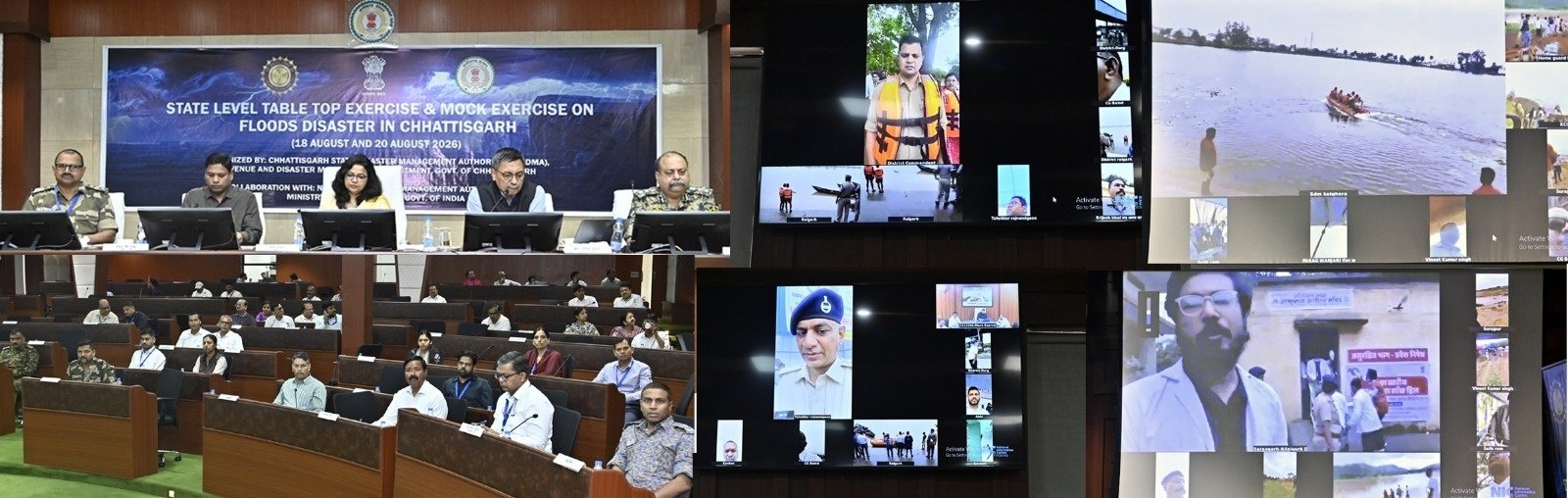
Revenue and Disaster Management Secretary Shammi Abidi and senior officials monitor Chhattisgarh’s statewide flood-response mock exercise from the state-level control centre in Nava Raipur on Thursday, August 20, 2026. Live video feeds showed rescue teams conducting evacuation, boat-rescue and relief operations at designated sites across different districts-Photo Credit:channel24india.com via CG/DPR
Senior officials examine early-warning systems, inter-departmental coordination, rescue operations, relief camps and medical preparedness
Key Highlights
- State-level table-top exercise held at Mahanadi Bhawan in Nava Raipur
- Potential flood scenarios used to test departmental roles and emergency decision-making
- Special emphasis placed on advance warnings to downstream villages
- NDRF, SDRF, Army, Home Guards and other response agencies participated
- Statewide mock exercise scheduled across Chhattisgarh on August 20
Raipur: Chhattisgarh reviewed its preparedness for potential flood emergencies through a state-level table-top exercise involving senior government officials, disaster-response agencies and representatives of essential-service departments.
The exercise was organised at Mantralaya Mahanadi Bhawan in Nava Raipur on Tuesday August 18, 2026 by the Chhattisgarh State Disaster Management Authority and the Revenue and Disaster Management Department in collaboration with the National Disaster Management Authority under the Union Ministry of Home Affairs.
Video footage from the programme shows senior officials examining different flood-emergency scenarios in the presence of representatives from the armed forces, police, disaster-response units and other government departments.
The exercise assessed how quickly warnings could be communicated, rescue teams mobilised, relief camps established and essential services restored during a major flood. It also examined whether departments understood their individual responsibilities and could work together without delay or confusion.
Revenue and Disaster Management Secretary Shammi Abidi said every official deployed at the field level must clearly understand his or her responsibilities during an emergency. She stressed that gaps in coordination between departments should be identified and addressed before an actual disaster occurs.
Abidi called for prompt decision-making, effective utilisation of available resources and strong coordination among all departments and response agencies. The objective, she said, was to ensure that every participating agency could act immediately after receiving information about a developing emergency.
Officials discussed the importance of forecasts and warnings issued by the India Meteorological Department and the Central Water Commission. Particular attention was given to monitoring rising water levels and issuing advance alerts to villages located downstream of rivers, reservoirs and dams.
The exercise also reviewed mechanisms for transmitting warnings through district administrations, local authorities and public-information systems so that vulnerable communities could be evacuated before conditions became dangerous.
Arrangements for temporary relief camps, food, drinking water, sanitation and essential medicines were examined. Health Department officials discussed the deployment of medical teams and measures required to prevent disease outbreaks in flood-affected settlements and relief camps.
Departments Put Coordination and Response Systems to Test
Flood response requires simultaneous action by several government departments and emergency agencies. The table-top exercise therefore examined the responsibilities of the Water Resources, Health, Public Works, Telecommunications, Animal Husbandry, Transport and Energy departments.
The preparedness and availability of the National Disaster Response Force, State Disaster Response Force, Fire and Emergency Services, Army, Home Guards, Civil Defence, National Cadet Corps, Bharat Scouts and Guides and trained Aapda Mitra volunteers were also reviewed.
Participants discussed the deployment of rescue teams, boats, vehicles, medical personnel and communication equipment. The exercise assessed whether resources available in one district could be moved quickly to another district facing a severe emergency.
The discussion also covered the restoration of damaged roads, bridges, electricity supply and telecommunication networks. These services are critical for ensuring that rescue teams can reach affected communities and that district administrations remain connected with field personnel.
Animal rescue and the provision of fodder and veterinary assistance were included in the planning process because floods frequently affect livestock, which remain an important source of income for rural families.
NDRF officials provided operational guidance on flood rescue, evacuation and the deployment of specialised teams. Officials examined different situations, including sudden increases in water levels, the isolation of villages, disruption of road connectivity and the need for large-scale evacuation.
A central purpose of a table-top exercise is to identify weaknesses in disaster-management plans before an actual emergency. Unlike a field drill, it allows officials to discuss simulated situations, test decision-making procedures and clarify the chain of command without deploying all resources physically.
The August 18 exercise was followed by a comprehensive statewide mock exercise scheduled for August 20. District officials were expected to participate in simulated flood situations to test whether the plans discussed at the state level could be implemented effectively on the ground. The programme had been announced jointly by the state authorities and the NDMA to assess emergency coordination and response capabilities.
Senior Adviser to the National Disaster Management Authority Ravindra Gurung, Bihar State Disaster Management Authority Senior Adviser Dr Jeevan Kumar, CIF Senior Supervisor Gajendra Pathak and Revenue and Disaster Management Department Deputy Secretary Gajendra Thakur attended the exercise.
Officials from the Water Resources, Health, Telecommunications, Animal Husbandry and Public Works departments were present along with representatives of the NDRF, SDRF, Army, Home Guards and other response organisations. District disaster-management authorities and departmental officials joined the proceedings through videoconferencing.
The exercise sought to strengthen Chhattisgarh’s pre-disaster preparedness and ensure that relief and rescue operations could begin without avoidable delay. Effective advance warnings, clearly assigned responsibilities and close coordination between agencies can significantly reduce the loss of life and property during floods.
Revenue and Disaster Management Secretary Shammi Abidi and senior officials participate in the state-level table-top exercise on flood preparedness at Mantralaya Mahanadi Bhawan in Nava Raipur on Tuesday, August 18, 2026. Representatives of disaster-response agencies, the armed forces and essential-service departments reviewed early-warning, rescue and relief arrangements-Video Credit:channel24india.com via CG/DPR