Kumar Bahukhandi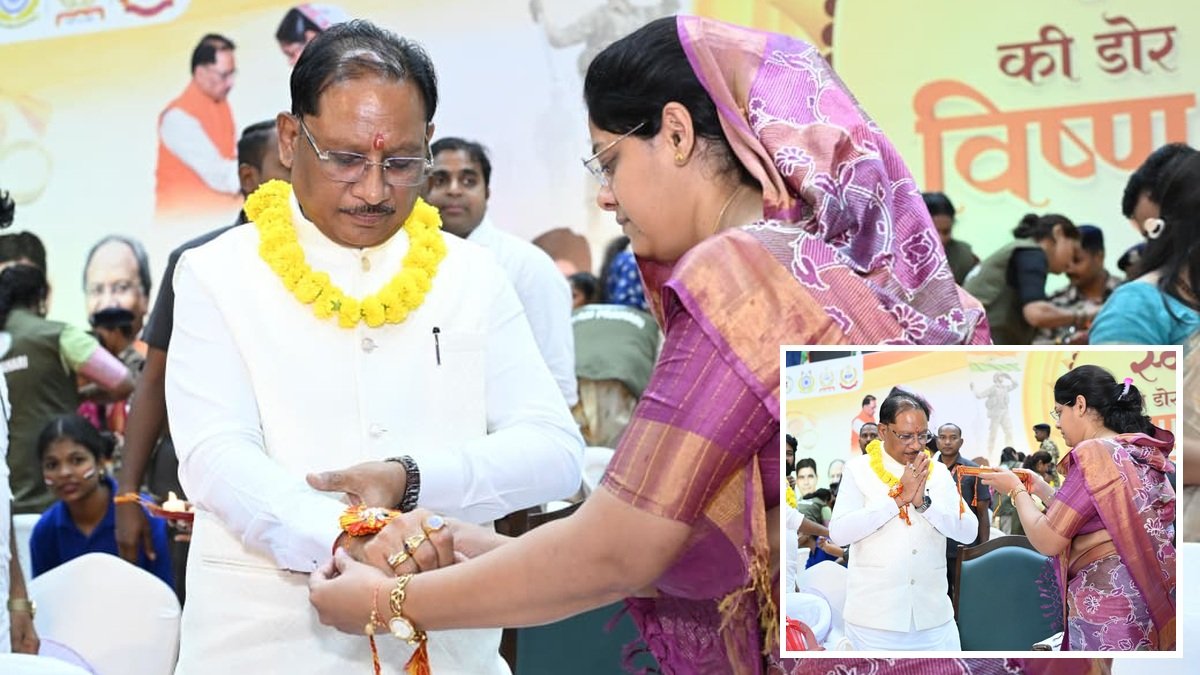
A bond beyond ceremony: Madhuri Verma, wife of martyred Sub-Inspector Yugal Kishore Verma, ties a rakhi on Chhattisgarh Chief Minister Vishnu Deo Sai’s wrist during the ‘Sneh Ki Dor’ programme at Balbir Singh Juneja Indoor Stadium in Raipur on Tuesday, August 25, 2026. An emotional Sai said he had never had a biological sister and that Madhuri had filled that void-Photo Credit:channel24india.com via CG DPR
When a martyr’s widow tied a rakhi on Vishnu Deo Sai’s wrist, an official ceremony turned into an intensely personal moment of remembrance, loss and belonging
Some moments in public life cannot be measured by speeches, protocol or the importance of the people occupying the stage. Their meaning lies in a simple human gesture.
At Raipur’s Balbir Singh Juneja Indoor Stadium on Tuesday, August 25, 2026, one such moment unfolded when Madhuri Verma, wife of martyred Sub-Inspector Yugal Kishore Verma, tied a rakhi on the wrist of Chhattisgarh Chief Minister Vishnu Deo Sai.
It was part of the ‘Sneh Ki Dor’ programme, but for a few moments the ceremony ceased to be merely an official event.
Sai looked at the rakhi on his wrist and spoke about something intensely personal — the absence of a sister in his own life.
“I have no biological sister. We are all brothers. Today, Madhuri ji tied a rakhi on my wrist. I have found a sister who is even more than a biological sister to me.”
Those words gave the occasion a meaning far beyond the ritual of Raksha Bandhan.
Here was a woman whose husband had made the ultimate sacrifice while confronting Naxal violence. She had lived with a loss that no public honour or official recognition could erase. Yet, carrying that memory with her, she came forward to tie the traditional thread of a sister’s affection and trust.
And standing before her was a Chief Minister who, for that moment, did not respond merely as the head of a government.
He responded as a brother.
A Rakhi Carrying the Memory of a Martyr
The rakhi on Sai’s wrist represented two relationships at once. One was newly expressed — between Madhuri and the man she addressed through the timeless symbolism of brother and sister. The other remained invisible but profoundly present: her bond with her late husband, Sub-Inspector Yugal Kishore Verma.
His sacrifice was the reason this particular rakhi carried such emotional weight.
Sai assured Madhuri that the family of the martyr was his own family and stressed that the families of those who laid down their lives must never be allowed to feel alone.
“The families of our martyrs are never alone. Sharing their happiness and sorrow, safeguarding their honour and caring about their future is not merely the responsibility of the government; it is an emotional duty for all of us.”
His next sentiment made the relationship still more personal.
“Today, sister Madhuri has tied a rakhi to me. As her brother, my responsibility towards her family has become even deeper.”
There is an important distinction in those words.
Governments can provide assistance. Administrations can frame policies. States can honour martyrs and support their families. But a relationship expressed through the word sister carries a different expectation — one of continuity, remembrance and personal responsibility.
That is what made this particular moment stand apart.
Sai paid tribute to Yugal Kishore Verma and acknowledged the debt Chhattisgarh owes to its security personnel and their families.
“Our brave soldiers sacrificed their today so that future generations of Chhattisgarh could have a safer tomorrow.”
For Madhuri, the rakhi could never replace what was lost.
For Sai, it could not literally create the childhood relationship with a sister he never had.
But for a few deeply human moments in Raipur, the two experiences met.
A woman who had lost her husband in the service of the State found a brother extending his hand in acknowledgement of that sacrifice. A man who publicly acknowledged that he had never had a sister found one tying a rakhi around his wrist.
That thin thread carried grief, gratitude, trust and a promise.
And perhaps that is why the photograph of the moment says more than an official communiqué ever could.