Kumar Bahukhandi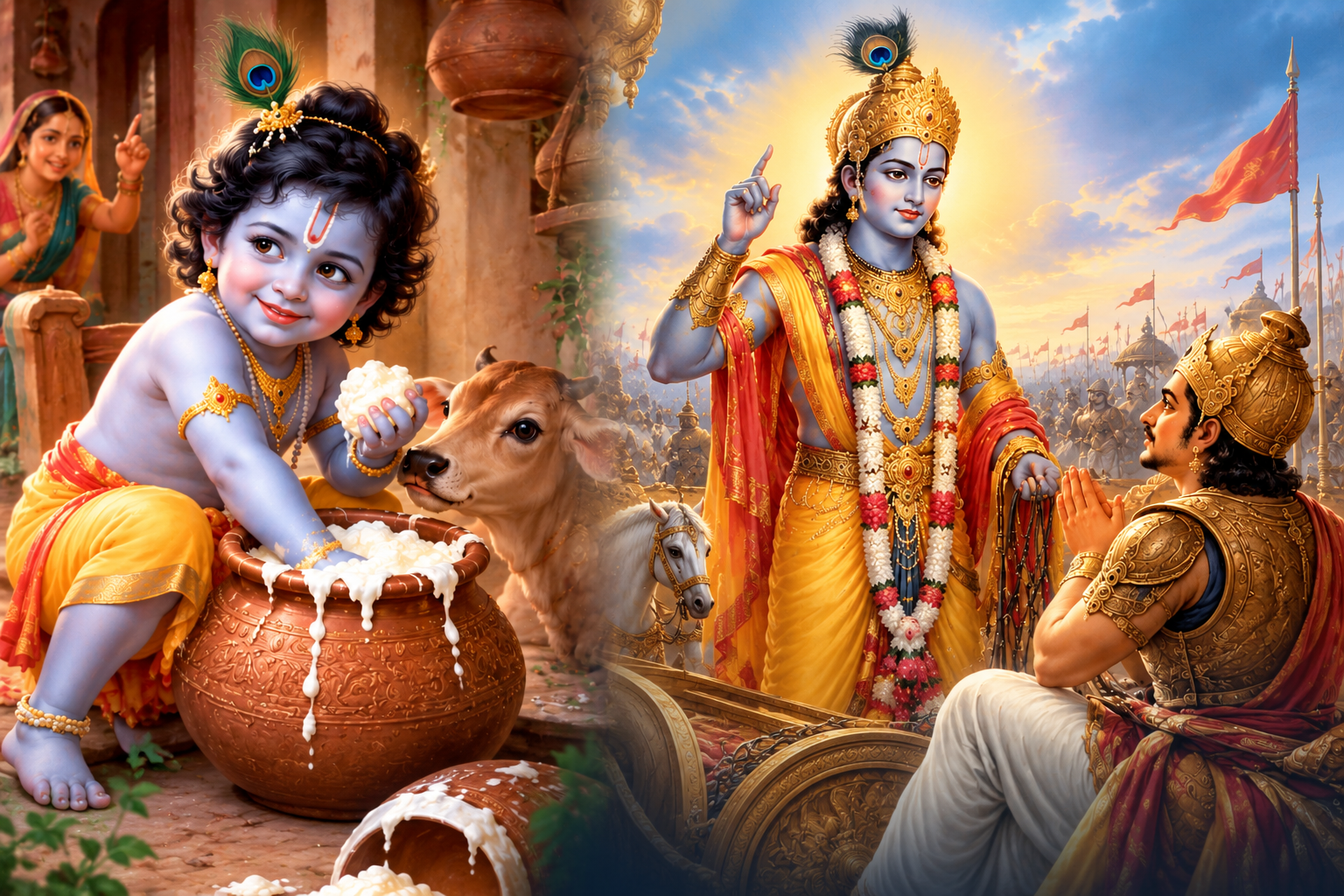
From butter-loving Bal Krishna of Gokul to the divine guide of Arjuna at Kurukshetra — an extraordinary journey from childhood mischief to the timeless wisdom of the Bhagavad Gita-Photo Credit:channel24india.com.
From the child of Mathura and the playful companion of the gopas in Braj to the charioteer at Kurukshetra, Krishna’s journey is not merely a movement through places and events. It is an extraordinary passage from innocence to responsibility, from affection to duty, from the music of the flute to the eternal questions of human existence.
There is something almost unbelievable about the distance between the two most familiar images of Krishna.
In one, there is a little boy with butter on his hands, mischief in his eyes and complaints against him reaching Yashoda. There are cows wandering through green pastures, young companions running beside him, gopis drawn towards the music of his flute and the Yamuna flowing quietly through a world that generations would remember as Braj.
In the other, there is no flute.
There is a conch, a chariot, two armies and a warrior who suddenly does not want to fight.
Krishna is no longer running with the gopas. He is holding the reins of Arjuna’s horses.
The mischievous child has become a statesman. The flute-player has become a counsellor. The boy whose childhood stories make people smile is now answering questions about life and death, action and inaction, duty and desire, attachment and liberation.
And what he says on that battlefield becomes the Bhagavad Gita.
How did the journey travel so far?
Perhaps that is one of the reasons Krishna remains among the most fascinating personalities in India’s spiritual and cultural consciousness. His life cannot be captured by one age, one role, one emotion or even one philosophy.
He laughs.
He plays.
He loves.
He fights injustice.
He negotiates.
He withdraws when withdrawal is wiser than vanity.
He builds alliances.
He accepts responsibility.
And when a mighty warrior collapses emotionally before the greatest battle of his life, Krishna does something even more remarkable: he talks to him.
The journey towards that conversation begins under circumstances in which conversation itself seems impossible.
Krishna is born in Mathura, not amid celebration and freedom, but under the shadow of imprisonment and death.
His parents, Devaki and Vasudeva, are prisoners of Kansa. A prophecy hangs over the ruler: Devaki’s eighth child will become the cause of his destruction.
Kansa responds as frightened power often does. He attempts to destroy the future before the future can challenge him.
Yet the child survives.
Vasudeva carries the newborn Krishna across the Yamuna to Gokul. The imagery has been told and retold for centuries—the storm, the river, the journey through darkness and the infant being taken towards safety.
The circumstances of his birth are political, violent and dangerous.
His childhood, however, becomes almost their opposite.
Before the Battlefield, There Was Braj
In Gokul and Vrindavan, Krishna belongs to everybody.
He is Yashoda’s troublesome child, Nanda’s son, the companion of cowherd boys and the source of endless exasperation and affection among the women of Braj.
The butter-stealing stories matter not because butter itself is important, but because they bring the divine into the most ordinary corners of domestic life.
Krishna does not remain distant.
He enters homes.
He gets caught.
He is complained about.
He is scolded.
He makes excuses.
He plays with children.
The extraordinary is presented through the language of the ordinary.
This may explain why the Krishna of childhood has remained so deeply embedded in popular imagination. People do not merely worship him; they feel permitted to love him, tease him, complain to him and even argue with him.
His divinity does not eliminate intimacy.
Then there is the flute.
Few objects in Indian cultural memory carry so much meaning with so little material presence. A hollow piece of bamboo becomes inseparable from Krishna.
The flute commands nobody.
It threatens nobody.
It does not issue instructions.
It simply calls.
The gopis hear it. The gopas know its sound. Braj gathers around it. In later devotional traditions, the flute becomes a metaphor for surrender, attraction and the mysterious call of the divine.
But Krishna’s childhood is not merely an uninterrupted festival of innocence.
Danger repeatedly enters Braj.
The stories of Putana, Kaliya and the other threats surrounding the young Krishna remind us that darkness has followed him from Mathura. Even in the landscape of play, responsibility is quietly taking shape.
The child is already a protector.
Still, Braj cannot hold him forever.
And this is where Krishna’s story begins to acquire a distinctly human poignancy.
Growing up means leaving something behind.
Krishna must leave the people who love him.
He must return towards Mathura and confront the world from which he had once been carried away as an infant.
The boy who escaped Kansa must now face Kansa.
Childhood gives way to history.
When Krishna Leaves the Flute Behind
The defeat of Kansa might have provided a convenient ending for a simpler hero.
The tyrant falls. Justice triumphs. The hero wins.
But Krishna’s journey refuses to end there.
Because life after victory continues.
New enemies emerge. Kingdoms have to survive. Communities require protection. Alliances matter. Political decisions have consequences. Sometimes courage means confronting an adversary; at other times wisdom lies in refusing to sacrifice people merely to satisfy the prestige of rulers.
The world of Krishna becomes larger and morally more complicated.
Eventually, Dwarka emerges as another defining landscape of his life.
By now the child of Braj has travelled an enormous distance—not simply geographically, but in responsibility.
He becomes a figure of political intelligence and diplomacy.
This aspect of Krishna is sometimes overshadowed by either the charming child of Vrindavan or the divine teacher of the Gita. Yet the statesman between these two figures is essential to understanding the journey.
Krishna knows that righteousness does not operate in a vacuum.
It must survive in a world containing ambition, jealousy, pride, deception, loyalty, family relationships and competing claims of duty.
Then come the Pandavas and Kauravas.
And eventually, Kurukshetra.
Here the story reaches its astonishing reversal.
Krishna, capable of influencing kings and armies, chooses not to fight.
Arjuna chooses Krishna himself rather than Krishna’s army, and Krishna becomes his charioteer.
Consider that image for a moment.
The man around whom kingdoms and warriors revolve voluntarily takes the driver’s place.
He holds the reins.
There is a lesson even before the Gita begins.
Power does not always need the throne.
Leadership does not always occupy the highest seat.
Sometimes the person who guides history is the one apparently sitting in front simply holding the reins.
And then Arjuna asks Krishna to take the chariot between the two armies.
Krishna does.
What Arjuna sees there destroys his certainty.
When the Warrior Does Not Want to Fight
Arjuna had arrived at Kurukshetra as a warrior.
He knew how to fight. He had trained for it. He possessed extraordinary skill. The question was not whether his hands were capable of using the bow.
The crisis was whether his conscience would allow them to do so.
Across the battlefield stood people who were not strangers.
Teachers.
Relatives.
Elders.
Friends.
Members of his own extended family.
Suddenly the language of victory becomes hollow.
What is a kingdom worth if acquiring it requires killing those with whom one might have shared it?
Arjuna’s bow slips.
The warrior who could confront armies cannot resolve the battle taking place inside himself.
And this is precisely where the Bhagavad Gita begins.
That fact deserves attention.
One of the world’s most influential philosophical dialogues does not begin because a student calmly approaches a teacher seeking abstract knowledge.
It begins because a human being breaks down.
Arjuna is confused, emotionally overwhelmed and unable to determine what is right.
His problem is remarkably modern.
What should we do when every choice appears morally compromised?
Should emotion decide duty?
Can refusing to act itself become an action with consequences?
How does one distinguish compassion from avoidance?
How can a person perform a difficult responsibility without being consumed by ambition, fear or the desire for reward?
Krishna does not answer with a convenient slogan.
The conversation moves through duty, action, knowledge, discipline, devotion, the nature of the self and the relationship between the temporary and the eternal.
And from this conversation emerges one of the Gita’s most enduring principles: perform the action that is yours to perform, but do not make yourself a prisoner of its fruits.
This is not an argument for indifference.
Quite the opposite.
Krishna asks Arjuna to act fully while loosening the ego’s demand to control every consequence.
It is an extraordinarily difficult proposition.
Human beings generally act because they want something.
Recognition.
Victory.
Money.
Love.
Power.
Security.
Revenge.
Approval.
The Gita asks whether action can rise above this endless bargaining with outcomes.
That question is as relevant in an office, a family, a classroom or public life as it was symbolically on the battlefield.
The Flute and the Chariot Were Never Opposites
At first sight, the Krishna of Braj and the Krishna of Kurukshetra appear almost impossible to reconcile.
One represents play.
The other responsibility.
One carries a flute.
The other holds reins.
One is surrounded by gopas and gopis.
The other stands between armies.
One steals butter.
The other discusses the immortality of the self.
Yet perhaps this contrast is precisely the point.
Human life itself contains all these worlds.
Nobody remains forever in childhood.
There are periods when life resembles Braj—friendship, family, laughter, affection, music and the feeling that tomorrow can wait.
Then, sooner or later, everyone encounters a Kurukshetra.
Not necessarily a battlefield of weapons.
A difficult decision can be Kurukshetra.
Choosing between personal affection and professional responsibility can be Kurukshetra.
Standing against somebody one loves can be Kurukshetra.
Accepting an unpleasant truth can be Kurukshetra.
Ageing can be Kurukshetra.
Loss can be Kurukshetra.
The conflict between what we want and what we believe we ought to do is perhaps the most common Kurukshetra of all.
This is where Krishna’s long journey acquires its deeper coherence.
The Gita is not spoken by someone who has remained outside life.
Krishna has already experienced relationships, separation, danger, responsibility, political conflict and the burden of decisions.
The teacher at Kurukshetra knows the colour of Braj.
He has heard laughter before hearing the conches of war.
He has played the flute before holding the reins.
That makes the journey all the more compelling.
Krishna Does Not Ask Arjuna to Escape Life
There is another reason the Gita has travelled so far beyond its original setting.
Krishna’s answer to confusion is not simply withdrawal.
He does not tell Arjuna that the world is difficult and therefore should be abandoned.
He asks him to understand his responsibility and then enter the world with greater clarity.
This distinction is important.
Spirituality can easily be misunderstood as escape—a retreat from difficult people, difficult duties and difficult consequences.
Krishna offers something more demanding.
Remain in life.
Act.
But understand why you act.
Perform your responsibility without allowing success to intoxicate you or failure to destroy you.
Care deeply without assuming that everything belongs to you.
Participate without becoming possessed by possession itself.
This is easier to admire than to practise.
Perhaps that is why the Gita continues to be read rather than merely remembered.
Every generation discovers its own Arjuna within it.
There is a beautiful question hidden inside Krishna’s journey.
Where did the flute go?
The Krishna of Kurukshetra is rarely imagined playing it.
Perhaps the answer need not be literal.
The flute belongs to one stage of the journey, the chariot to another.
Life does not always permit us to carry the symbols of childhood into every responsibility of adulthood.
But what the flute represented need not disappear.
Joy need not disappear when duty arrives.
Love need not disappear when judgement becomes necessary.
Inner freedom need not disappear because the world has become complicated.
The same Krishna who once attracted people through music later guides Arjuna through wisdom.
The instrument changes.
The act of guidance remains.
At Braj, people move towards Krishna after hearing his flute.
At Kurukshetra, Arjuna moves towards clarity after hearing his words.
Perhaps the distance between the flute and the Gita is not as great as it initially appears.
Both are calls.
One reaches the heart through music.
The other reaches a confused human being through knowledge.
An Incredible Journey — and a Human One
Krishna’s journey begins in a prison but refuses to be imprisoned by circumstance.
It passes through the waters of the Yamuna into the arms of Yashoda.
It runs barefoot through the childhood landscapes of Gokul and Vrindavan.
It plays among the gopas.
It becomes inseparable from the affection of the gopis.
It confronts Kansa.
It moves through the responsibilities of Mathura and Dwarka.
It enters diplomacy and politics.
It attempts to navigate a conflict that human pride has made increasingly unavoidable.
And finally it arrives at Kurukshetra, where the warrior is silent and the charioteer speaks.
What a distance between those two moments—the infant carried secretly through a stormy night and the teacher calmly explaining existence amid armies waiting for war.
Yet the extraordinary thing is that neither image cancels the other.
The philosopher does not erase the mischievous child.
The statesman does not erase the flute-player.
The charioteer does not erase Yashoda’s Krishna.
They remain together.
That completeness may explain Krishna’s enduring hold over imagination.
He does not represent only renunciation or only enjoyment, only power or only tenderness, only philosophy or only action.
He embraces life’s contradictions and then asks human beings to discover balance within them.
Perhaps this is why Krishna cannot be understood merely by asking whether he was the child of Mathura, the cowherd of Braj, the beloved flute-player, the destroyer of Kansa, the statesman of Dwarka, the friend of Arjuna or the teacher of the Bhagavad Gita.
He is remembered as all of them.
And therein lies the wonder of the journey.
Before the wisdom of the Gita came the music of the flute. Before the battlefield came the playgrounds of Braj. Before Krishna taught humanity how to face its duties, he had first shown it how completely life could be lived.
From Mathura to Gokul, from Vrindavan to Dwarka, and finally to the battlefield of Kurukshetra, Krishna’s journey is therefore more than the story of movement from one place to another.
It is a journey through the many stages of existence itself.
The flute eventually falls silent.
The chariot eventually stops.
The armies of Kurukshetra are long gone.
But the conversation that began when one troubled man lowered his bow continues.
And perhaps that is Krishna’s most incredible journey of all:
from the playgrounds of Braj into the questions that still live within the human mind.