Kumar Bahukhandi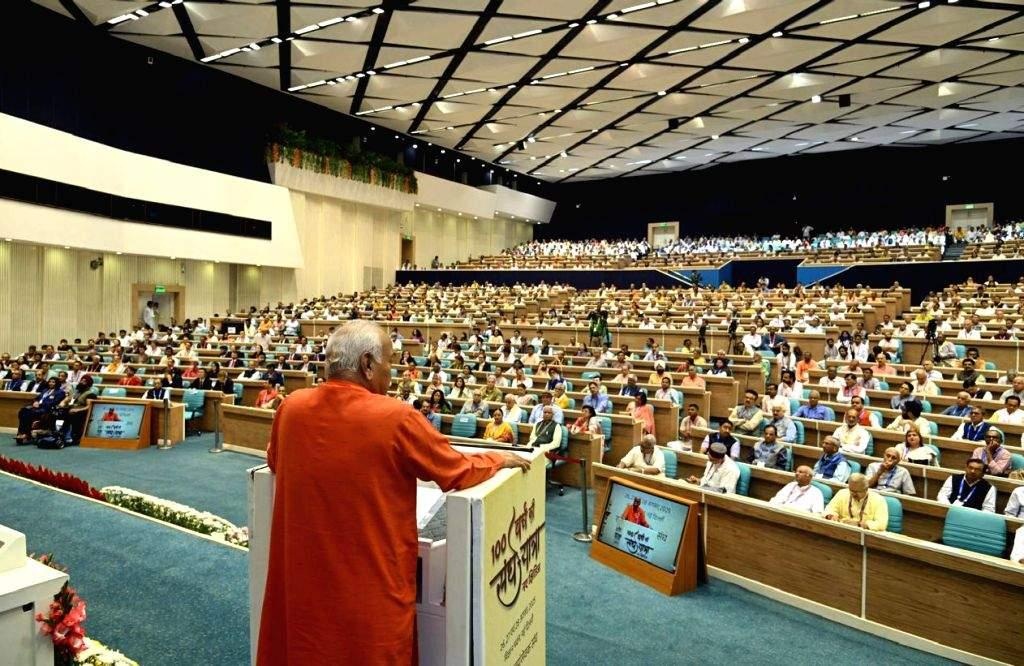
RSS chief Mohan Bhagwat speaks at the Vishwa Mangalya Sabha in New Delhi, where he urged society to engage with young people through “discussion, not dictation” and “consensus, not orders.” His remarks came a day before Union Education Minister Dharmendra Pradhan stepped down amid the NEET paper-Photo Credit -channel24india.com ( Representational Image- File Photo)
The timing of the RSS chief’s remarks and the Education Minister’s resignation has sparked debate—but what do the facts suggest?
Politics often turns on timing.
On July 24, RSS chief Mohan Bhagwat delivered a speech urging society to engage with young people through “discussion, not dictation” and “consensus, not orders.” Less than twenty-four hours later, Union Education Minister Dharmendra Pradhan resigned amid the controversy over the NEET paper leak and continuing student protests.
The sequence of events has naturally prompted one question:
Was Bhagwat’s speech merely philosophical, or did it reflect a broader recognition that the government needed to respond differently to growing public anger?
There is no official evidence that Bhagwat’s remarks directly prompted Pradhan’s resignation. Neither the RSS nor the Union Government has linked the two developments.
However, the close timing has made the speech politically significant.
More Than a Speech on Youth
Bhagwat did not mention NEET, Dharmendra Pradhan or the protests by name.
Instead, he spoke about changing generations.
He observed that today’s youth no longer accept decisions simply because they come from authority. They expect explanations, transparency and participation.
His message was simple:
Society cannot engage young people through commands alone. It must earn their trust through dialogue.
Although delivered in a broader social context, those remarks resonated strongly because student protests had become one of the country’s biggest public issues.
A Changed Political Atmosphere
By the time Bhagwat spoke, the government had already faced weeks of criticism over examination irregularities.
Students had demonstrated across the country.
Parents questioned the credibility of public examinations.
Opposition parties intensified their attacks.
Civil society groups demanded accountability.
Bhagwat’s emphasis on listening to youth appeared to echo a wider concern that public institutions needed to rebuild confidence rather than merely defend their actions.
The Resignation That Followed
The following day, Dharmendra Pradhan resigned.
The government simultaneously announced stronger legal measures, including amendments to the anti-paper leak law, tougher punishments, time-bound investigations and special fast-track courts.
These decisions indicate that the government chose to combine political accountability with institutional reform.
Whether that decision had already been taken before Bhagwat’s speech or whether the speech reflected broader internal thinking cannot be established from the public record.
What Was the Real Impact?
The immediate impact of Bhagwat’s remarks may not have been administrative.
Their greater significance was political and moral.
The speech shifted the conversation from defending authority to understanding public sentiment.
It reinforced an idea that governments, educational institutions and society cannot simply expect compliance from young people.
They must engage with them.
That message aligned closely with the concerns expressed by protesting students, even though Bhagwat never directly referred to their movement.
My View
It would be inaccurate to conclude that Mohan Bhagwat’s speech caused Dharmendra Pradhan’s resignation.
There is no public evidence supporting that conclusion.
However, it is equally difficult to ignore the timing.
Bhagwat’s appeal for dialogue came at a moment when student anger had reached its peak. Within a day, the government accepted the Education Minister’s resignation and accelerated reforms aimed at restoring confidence in the examination system.
Whether coincidence or convergence, the two developments together marked a turning point in the government’s response to the crisis.