Kumar Bahukhandi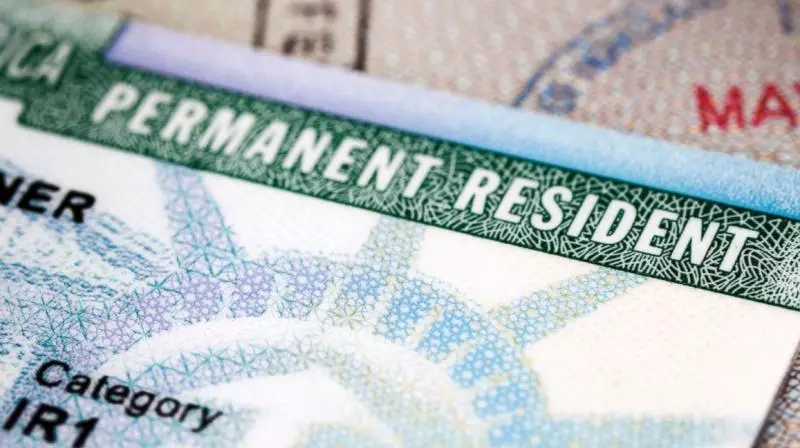
A close-up of a United States Permanent Resident Card, commonly known as a green card. The Trump administration suspended PERM labour certification processing for eight major technology companies, including Infosys, TCS, Wipro and HCL Technologies, on Thursday, October 8, 2026, raising concerns over employment-based permanent residency applications involving foreign professionals. Photo: Representational image.
Infosys, TCS, Wipro and HCL Technologies among eight major companies barred from a crucial employment-based permanent residency process; thousands of skilled foreign professionals could face uncertainty over their future in the United States.
Key Highlights
- Trump administration suspends green card-related labour certification processing for eight major technology companies.
- Indian IT giants Infosys, Tata Consultancy Services, Wipro and HCL Technologies among those affected.
- Microsoft, Adobe, Cognizant and Capgemini also face restrictions.
- US Vice President JD Vance accuses companies of replacing American workers with lower-paid foreign professionals.
- Existing H-1B visas and previously issued green cards are not automatically cancelled.
- Restrictions could complicate long-term residency plans for Indian technology professionals.
Washington Freezes Key Immigration Route for Technology Workers
The United States has imposed fresh restrictions on employment-based immigration, suspending a crucial green card-related process for eight leading technology and IT services companies, including some of India’s biggest software exporters.
The Trump administration announced on Thursday, October 8, 2026, that the US Department of Labor would stop accepting new applications and processing pending cases under the Permanent Labor Certification Programme, commonly known as PERM, involving the identified companies.
The decision affects Infosys, Tata Consultancy Services (TCS), Wipro, HCL Technologies, Cognizant, Capgemini, Microsoft and Adobe.
The move represents another significant development in Washington’s increasingly restrictive approach towards employment-based immigration and the hiring of foreign technology professionals.
US Administration Raises Allegations of Employment Visa Misuse
US Vice President JD Vance defended the decision, alleging that certain technology companies had used immigration programmes to replace American employees with lower-paid foreign workers.
Speaking about Microsoft’s hiring practices, Vance said:
“Our message to Microsoft is: You’re a great American company, but you’ve got to hire great American workers.”
US Labour Secretary Keith Sonderling confirmed that the government would neither accept fresh PERM applications nor continue processing pending applications involving the companies under suspension.
The administration has linked its decision to concerns over alleged immigration fraud, wage suppression and the displacement of American workers.
However, the government has not publicly released detailed company-specific findings establishing the alleged violations.
What Is the PERM Programme and Why Does It Matter?
The Permanent Labor Certification Programme is an important component of the American employment-based immigration system.
Under the programme, employers seeking to sponsor foreign professionals for permanent residency must demonstrate that qualified American workers are not available for the positions concerned and that employing foreign workers will not adversely affect prevailing wages or working conditions.
The certification is generally an initial requirement for several categories of employment-based green cards.
For Indian technology professionals working in the United States on H-1B visas, employer-sponsored permanent residency has traditionally been an important pathway towards establishing a long-term career and residence in the country.
The latest suspension could interrupt that process for employees whose applications depend on the affected companies.
Importantly, the decision does not automatically invalidate existing H-1B visas or green cards already issued to workers.
Indian Technology Companies Face Fresh Uncertainty
India’s IT services industry has maintained a substantial presence in the United States for decades, providing software development, consulting, digital transformation and technology support to American businesses.
Companies such as TCS, Infosys, Wipro and HCL Technologies have employed skilled professionals through a combination of local recruitment and international assignments.
The latest restrictions could create additional administrative and immigration challenges for affected employees seeking permanent residency.
However, the commercial impact on individual companies may differ considerably.
Recent industry data suggest that major Indian IT companies have reduced their dependence on employment-based green card sponsorship in recent years, partly through increased local hiring and changes in their workforce strategies.
Consequently, the restrictions may have a more immediate effect on individual employees’ immigration plans than on the overall operations of every affected company.
Microsoft Defends Its Recruitment Practices
Microsoft has challenged the suggestion that its immigration-related recruitment practices are primarily intended to replace American employees.
The company said approximately 80 per cent of its roughly 6,000 H-1B applications in the previous fiscal year involved extensions or changes of status for existing employees.
According to Microsoft, the remaining applications concerned individuals already legally present in the United States, while new hires through those applications represented approximately one per cent of its American workforce.
The company’s response illustrates the disagreement between the administration’s allegations and the technology industry’s defence of skilled foreign recruitment.
Immigration Restrictions Could Influence Global Talent Movement
The suspension comes amid a broader debate over America’s dependence on foreign-born engineers, scientists, software developers and technology specialists.
While the Trump administration maintains that tighter immigration controls are necessary to protect American employment opportunities, researchers and immigration specialists have warned that restricting permanent residency pathways could discourage international professionals from pursuing careers in the United States.
Such policies could eventually influence where multinational companies establish research facilities, expand engineering teams and invest in advanced technologies.
For India, the developments also raise questions about the future movement of skilled professionals between the two countries, particularly in artificial intelligence, software engineering, semiconductor development and digital infrastructure.
Balancing Domestic Employment With Technological Leadership
The decision comes at a time when the United States is seeking to strengthen its global leadership in artificial intelligence and advanced technology.
American technology companies continue to depend on specialised expertise, including internationally recruited professionals, to support research and innovation.
Protecting domestic employment remains a legitimate policy objective, but the long-term effectiveness of immigration restrictions will depend on whether they improve opportunities for American workers without weakening the country’s ability to attract specialised talent.
For Indian IT companies and their employees, the immediate priority will be understanding the scope of the suspension, assessing pending immigration applications and preparing for possible changes in workforce planning.
The latest development highlights an increasingly important reality of the global technology industry: immigration policy is becoming as influential as technological capability in determining where skilled professionals choose to build their careers.