Kumar Bahukhandi
Leader of Opposition Rahul Gandhi addresses the media while highlighting the injuries of a student protester following the Jantar Mantar demonstrations. His remarks accusing the Union Home Minister of either being “culpable or incompetent” over the police action sparked a sharp political confrontation in Parliament, with the government rejecting the allegations as unsubstantiated-Photo Credit-ANI
Raising questions is the Opposition’s duty—but allegations against constitutional authorities must ultimately rest on evidence, not political inference
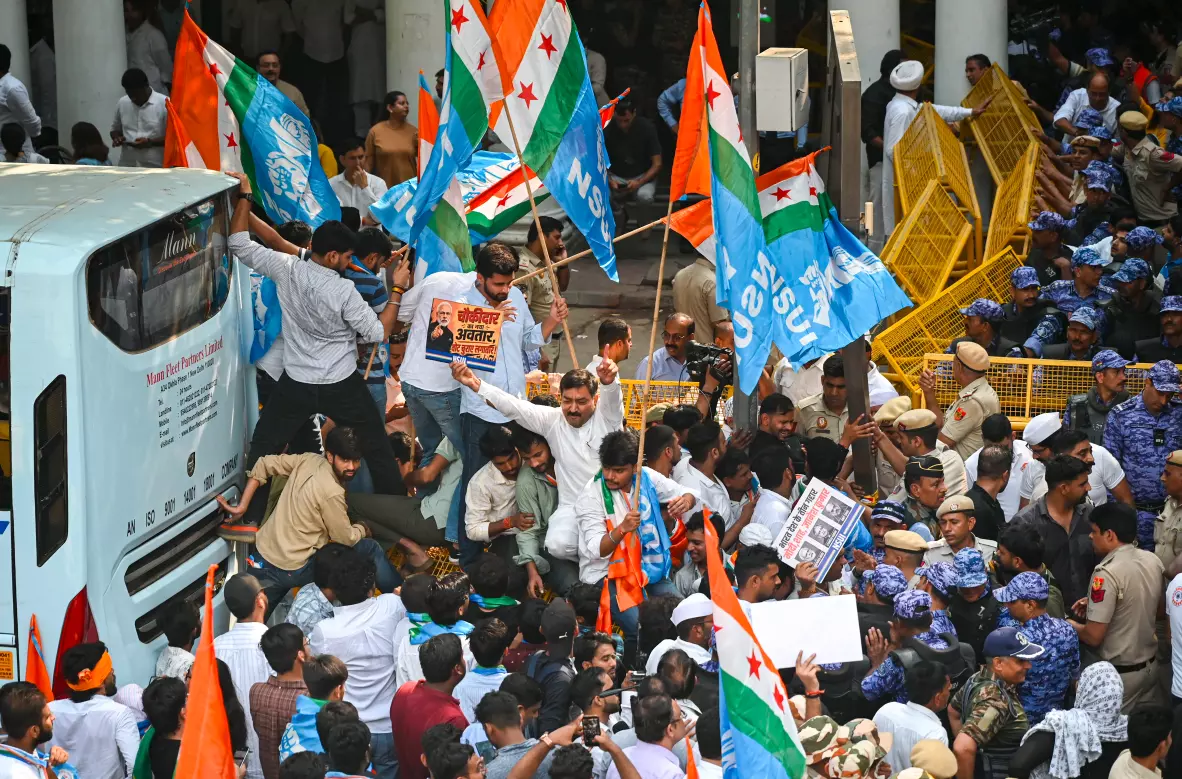
The events surrounding the student protests at Delhi’s Jantar Mantar have once again brought Parliament to the centre of a heated political confrontation. Instead of focusing solely on how such incidents can be prevented in the future, the debate has increasingly revolved around sharp political accusations, with Leader of Opposition Rahul Gandhi directly questioning Union Home Minister Amit Shah’s role in the police action.
Rahul Gandhi argued that there were only two possibilities: either the Home Minister ordered the police action, making him “culpable”, or he was unaware of it, making him “incompetent”. It was a politically forceful statement, but one that immediately invited an equally strong response from the Treasury benches.
Parliamentary Affairs Minister Kiren Rijiju dismissed the allegations as baseless, while Speaker Om Birla reminded members that personal accusations should be supported by facts rather than conjecture.
That reminder deserves attention.
In a parliamentary democracy, the Opposition has every right—and indeed every responsibility—to question the government. Holding the executive accountable is one of Parliament’s primary functions. However, accountability becomes stronger when questions are backed by verifiable evidence instead of assumptions about who must have known what.
“Strong democracies require strong questions—but they also require strong evidence.”
The larger concern is whether the political debate is overshadowing the real issue.
If students were subjected to excessive force during a protest, that deserves a transparent examination through appropriate legal and institutional mechanisms. At the same time, responsibility cannot be assigned solely through political speeches before facts are established.
The government, for its part, has maintained that law and order decisions are taken according to established procedures. It has also defended the police response as necessary under the prevailing circumstances. Whether those actions were proportionate remains a matter for lawful scrutiny rather than political assumption.
Interestingly, recent developments have also shown another side of the government’s approach. Following discussions between the Union Government and representatives of the Cockroach Janata Party (CJP), reports indicate that some states have begun withdrawing cases against student protesters. If implemented in accordance with legal procedures, such steps suggest that dialogue remains an important instrument for resolving conflict alongside law enforcement.
“Governments are judged not only by how they enforce the law but also by how they honour commitments made through dialogue.”
This is where the political narrative becomes more complex.
The Opposition portrays the incident as an assault on democratic dissent. The government argues that maintaining public order is a constitutional responsibility and that subsequent engagement with stakeholders demonstrates its willingness to resolve disputes peacefully.
Neither perspective alone tells the complete story.
For ordinary citizens—and especially for students—the priority is not political point-scoring but confidence that democratic protest, public safety and the rule of law can coexist.
The debate should therefore move beyond rhetorical questions such as whether a minister is “culpable” or “incompetent”. Instead, Parliament should focus on establishing facts, reviewing policing practices where necessary, and ensuring that both constitutional freedoms and public order remain protected.
“Political rhetoric may dominate headlines, but institutional accountability strengthens democracy.”
Ultimately, the strength of Indian democracy lies in its institutions. Governments must remain accountable. The Opposition must remain vigilant. But public confidence is best served when serious allegations are supported by credible evidence and when constitutional debates rise above political theatre.
My Views : Rahul Gandhi has frequently adopted a confrontational political style that relies on sharp rhetoric and immediate public reactions. His critics argue that many of his statements are made before all the facts are available, while his supporters see this as aggressive opposition politics. In this case too, the central question is whether the allegations against the Home Minister are supported by evidence or are primarily political messaging.