Kumar Bahukhandi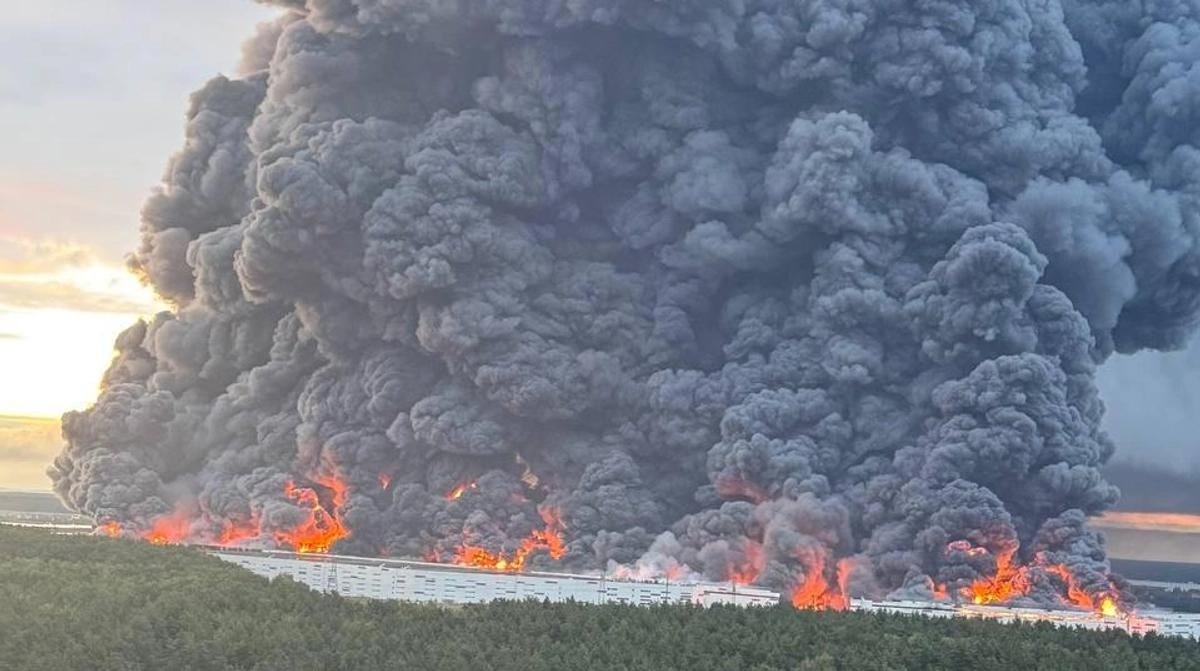
Thick black smoke rises from a Wildberries logistics complex near Podolsk in Russia’s Moscow region following a Ukrainian drone attack recently . The image illustrates Kyiv’s intensifying campaign against facilities it alleges support Russia’s military supply network. (Photo: Getty Images)
Early reports mentioned about 60 drones, but Russian officials later sharply revised the figure, claiming that more than 620 unmanned aircraft were directed towards the Moscow region
Key Highlights
- Russian authorities claim more than 620 drones were launched towards the Moscow region
- Moscow Mayor says at least 180 drones were intercepted overnight and 17 more later
- Airports and other transport operations faced temporary disruption
- Kyiv’s long-range campaign increasingly targets Russian military, energy and logistics facilities
- Russia claims most drones were intercepted; independent verification of the figures remains unavailable
- Russian missile attack on Ukraine’s Kharkiv region reportedly killed at least 10 people
Ukraine launched one of its largest drone attacks on Russian territory overnight into Tuesday, August 18, 2026, with Russian authorities claiming that more than 620 unmanned aircraft were directed towards Moscow and its surrounding region.
Initial reports suggested that approximately 60 Ukrainian drones had approached the Russian capital. However, Moscow Mayor Sergei Sobyanin subsequently released much higher figures, saying 180 drones had been destroyed over the Moscow region between Monday evening and 5 am on Tuesday. He later reported that 17 additional drones had been intercepted while travelling towards the capital.
Russian authorities claimed that Ukraine launched nearly 800 drones across different parts of the country during the wider overnight assault. The figures represent claims made by Russian officials and could not be independently verified.
No detailed assessment of the intended targets or the number of drones that penetrated Russian air defences was immediately available. Russia said most of the aircraft had been intercepted before reaching their objectives and initially reported no major casualties or widespread damage in the Moscow region from Tuesday’s attack.
The scale of the operation nevertheless demonstrated Ukraine’s growing ability to launch coordinated long-range attacks deep inside Russian territory. Kyiv has increasingly used domestically manufactured drones to target military installations, oil refineries, fuel depots, factories and logistics centres that it says contribute to Russia’s war effort.
Temporary restrictions were reportedly imposed on aviation and other transport operations as Russian air-defence units responded to the approaching drones. Moscow and its surrounding region have repeatedly faced airport closures and flight diversions during large-scale Ukrainian attacks.
Ukraine did not immediately provide a detailed account of Tuesday’s operation or publicly confirm the number of drones involved.
Long-Range Drone Campaign Intensifies
The latest assault followed another major Ukrainian attack on Russia on August 16, when a large logistics warehouse operated by e-commerce company Wildberries caught fire near Podolsk in the Moscow region.
Ukraine has accused Wildberries facilities of being used to store or transport components and other material supporting Russian military production. The company and Russian authorities have rejected those allegations.
Images from the August 16 attack showed thick black smoke rising from the warehouse complex. Russian officials reported civilian casualties in attacks across different regions, although Kyiv maintains that its long-range operations are directed towards military and war-supporting infrastructure.
Russia has warned that Ukraine’s use of increasingly advanced long-range drones could lead to further escalation. Moscow has also accused Britain of deepening its involvement in the conflict following reports that British-manufactured drones may have been used in strikes inside Russia.
The British government has not confirmed whether its drones were used in the latest operations but has reaffirmed its continuing military support for Ukraine.
The drone assault on Russia came as Moscow continued its own missile and drone attacks on Ukrainian territory. A Russian strike on the village of Pechenihy in Ukraine’s Kharkiv region reportedly killed at least 10 civilians and injured 17 others.
Ukrainian officials said houses and other local buildings were damaged in the attack. President Volodymyr Zelenskyy condemned the strike and said Russia was continuing to target civilians.
The exchange of large-scale aerial attacks illustrates the increasingly important role of unmanned weapons in the war. Both countries are attempting to overwhelm air-defence systems by launching drones in large numbers, often combining them with missiles and decoy aircraft.
Ukraine’s attacks are intended partly to disrupt the Russian military’s fuel, manufacturing and supply networks. They also bring the consequences of the war closer to Moscow and other Russian cities that were once considered beyond the effective reach of Ukrainian weapons.
Russia, meanwhile, continues to target Ukraine’s energy infrastructure, industrial facilities and urban centres. Ukrainian officials accuse Moscow of attempting to damage electricity and heating systems ahead of winter.
The contrasting accounts issued after such attacks remain difficult to verify independently. Russia regularly reports destroying the majority of incoming Ukrainian drones, while Kyiv usually provides only limited operational information and often confirms individual targets several hours or days later.
What is clear is that the figure of 60 drones was only an early assessment of Tuesday’s attack. Subsequent Russian statements placed the number directed towards Moscow above 600 and the overall nationwide barrage at nearly 800, making it one of the largest reported Ukrainian drone operations of the war