Kumar Bahukhandi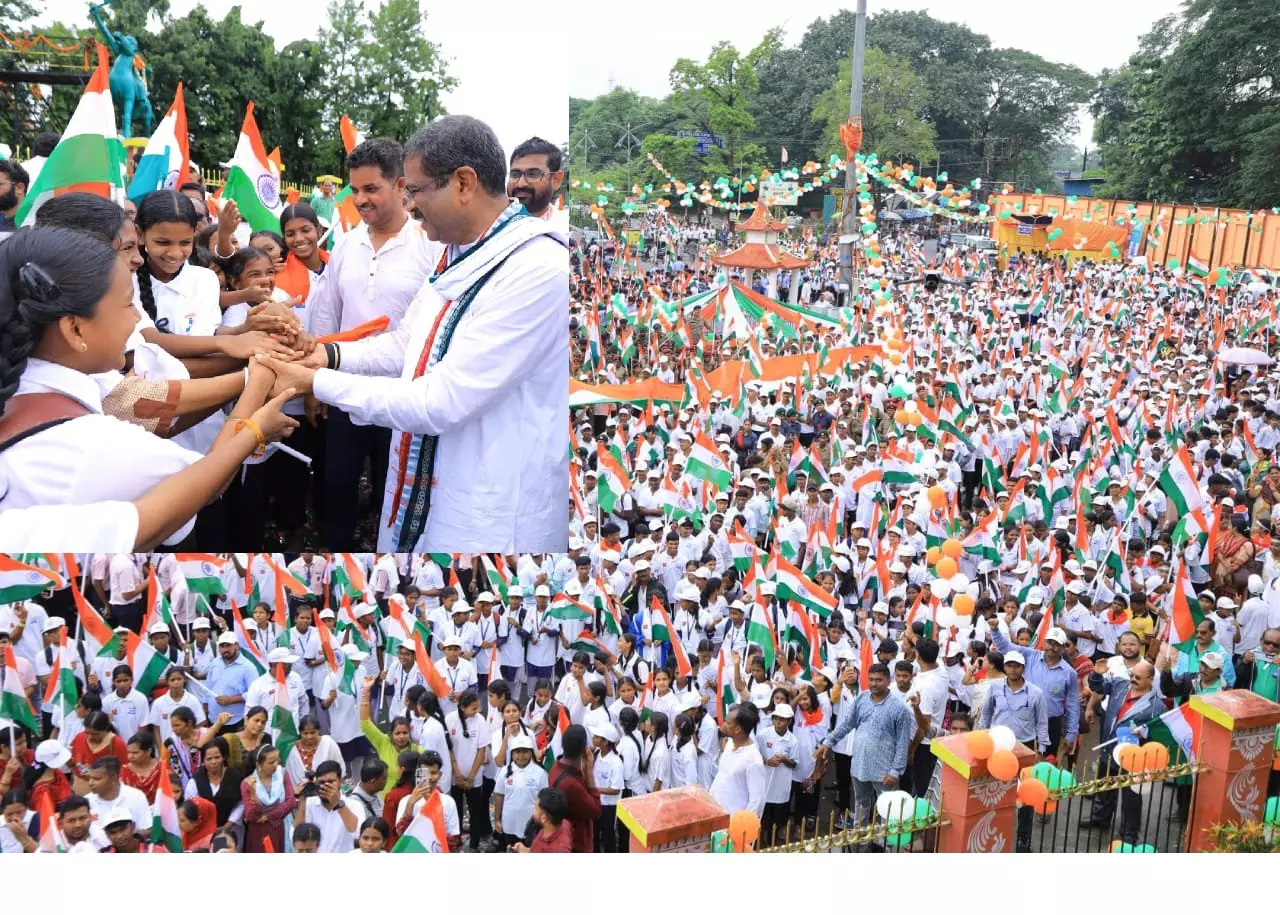
Former Union Minister and Sambalpur MP Dharmendra Pradhan interacts with schoolchildren during a Tiranga Padyatra in Sambalpur, Odisha, on Sunday, August 9, 2026 (inset), while a large gathering carrying the Tricolour participates in the march through the city. — Photo Credit: X/@dpradhanbjp
Former Union Minister’s growing constituency presence points to renewed grassroots focus as BJP seeks to consolidate its 2024 gains in Odisha
Sambalpur: Former Union Minister and senior Bharatiya Janata Party (BJP) leader Dharmendra Pradhan has stepped up his political engagement across his Sambalpur Lok Sabha constituency, with a series of public programmes and outreach initiatives coming at a time when the ruling BJP in Odisha is preparing for its next major electoral test.
Pradhan, whose political responsibilities have for years frequently taken him between Odisha and New Delhi, has lately been visibly increasing his presence in Sambalpur and adjoining areas of his parliamentary constituency spread across parts of Deogarh, Angul and Jharsuguda districts.
His rallies, public meetings and outreach programmes have attracted sizeable participation, giving his latest political engagement significance beyond that of routine constituency visits. A major public programme at Rairakhol followed by a Tiranga Padyatra in Sambalpur has further underlined his renewed emphasis on direct engagement with people.
The timing is politically significant. The BJP, which formed its first government in Odisha in 2024 after ending the Biju Janata Dal’s long rule, now faces the challenge of consolidating that electoral breakthrough at the grassroots. Rural elections will test not merely the popularity of the State government but also the depth of the party’s organisation beyond Assembly and Lok Sabha contests.
For Pradhan, Sambalpur occupies a particularly important place in that political equation. His increased presence in the constituency can be viewed both as an effort to strengthen his personal connect with voters and as part of the BJP’s wider attempt to deepen its organisational network.
His participation in public programmes alongside Panchayati Raj Minister Rabi Narayan Nayak, party workers, intellectuals, students and young people also gives the outreach an organisational dimension. Such programmes allow political leaders to move beyond formal rallies and establish contact with different sections of society.
Pradhan has played a significant role in the BJP’s growth in Odisha over the years. During the decade preceding the party’s historic victory in the State in 2024, he emerged as one of its most prominent national faces from Odisha and remained closely associated with efforts to expand the party’s political footprint.
His present activism, therefore, assumes greater significance at a time when the BJP is seeking to convert its electoral success into a durable organisational base.
There is another political dimension. Having represented Sambalpur in the Lok Sabha, Pradhan has his own constituency to nurture. National stature can provide political visibility, but parliamentary politics ultimately requires sustained contact with voters, local workers and community organisations.
His recent programmes may therefore be read as an attempt to ensure that his national political profile remains firmly anchored in his constituency.
The Tiranga Padyatra also provides an interesting example of this approach. A programme centred on the national flag carries a broader patriotic message, but at the constituency level it simultaneously provides an opportunity for interaction with students, young people, party workers and ordinary citizens. The images of Pradhan engaging with schoolchildren amid a large gathering illustrate the public-contact dimension of such programmes.
At the same time, crowd mobilisation by itself cannot be treated as a reliable measure of electoral strength. Political gatherings may demonstrate visibility and organisational capacity, but rural elections are fought through a much more complex network of local equations.
Panchayat-level leadership, booth organisation, caste and community dynamics, the performance of the State government and people’s assessment of development work can ultimately matter more than the size of individual political programmes.
That will be the real test for the BJP as it prepares for the next round of grassroots politics in Odisha.
For Pradhan too, the challenge will be to translate increased visibility into sustained political engagement. His Sambalpur constituency encompasses areas with differing local priorities, and maintaining a regular presence across this geographically and politically diverse parliamentary seat will be important.
There is also a longer horizon. The next Lok Sabha election may still be some distance away, but experienced politicians rarely wait for an election year to begin nurturing their constituencies. Building relationships with local organisations, responding to development concerns and keeping party workers politically engaged are continuing exercises.
Viewed in that context, Pradhan’s current Sambalpur push could serve two purposes: helping the BJP strengthen its grassroots machinery ahead of the rural polls while simultaneously consolidating his own political base for the years ahead.
The BJP’s 2024 victory changed Odisha’s political landscape, but winning power and retaining political dominance are two different challenges. The party must now demonstrate that its support can be sustained beyond the wave that brought it to office.
Pradhan’s renewed constituency engagement appears to fit into that larger political picture.
The immediate challenge, however, is to convert crowd mobilisation into durable organisational support. Large gatherings can demonstrate popularity and political energy, but electoral politics ultimately depends on booth-level organisation, credible local leadership and the ability of a government and its representatives to deliver on development promises.
Pradhan’s Sambalpur push, therefore, may be less about a momentary show of strength and more about laying the groundwork for the next phase of Odisha’s political contest.