Kumar Bahukhandi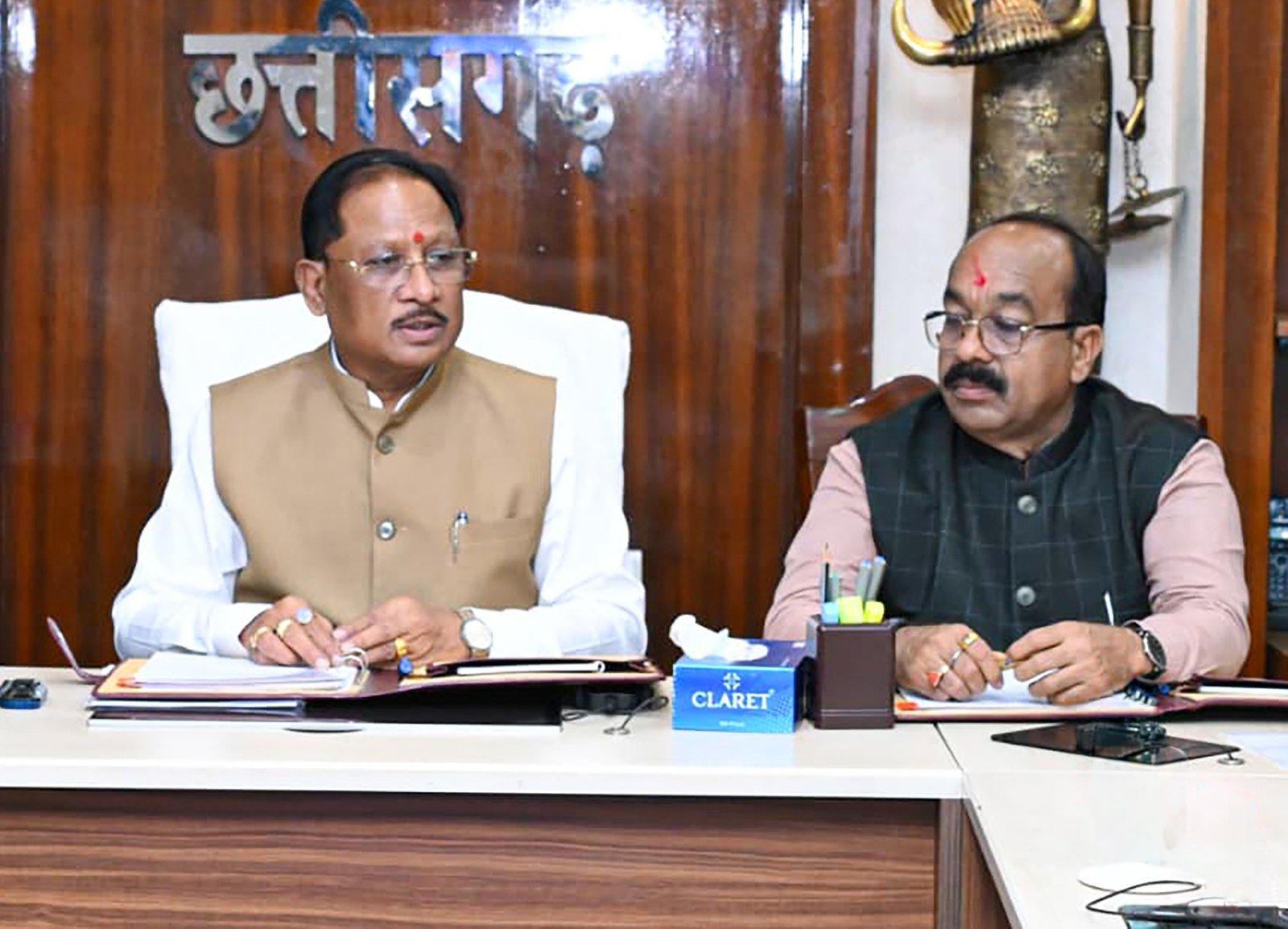
Chief Minister Vishnu Deo Sai (left) and Deputy Chief Minister Arun Sao (right) during a Chhattisgarh Cabinet meeting on Sunday, October 11, 2026, at 12 noon at the Chief Minister’s Residence Office in Civil Lines, Raipur. The Cabinet approved renaming the Tribal Development Department as the Tribal Affairs Department and cleared the recruitment of former Agniveers against 36 vacant police constable posts. Photo: channel24india.comvia CG/CMO
Chhattisgarh Cabinet also reviews preparations for President Droupadi Murmu’s visit, adopts a resolution marking Prime Minister Narendra Modi’s 25 years in executive leadership and reiterates its commitment to Viksit Bharat 2047
Key Highlights
- Cabinet approves renaming the Tribal Development Department (Adim Jati Vikas Vibhag) as the Tribal Affairs Department (Janjatiya Karya Vibhag).
- Amendment to the Chhattisgarh Government Business (Allocation) Rules approved to facilitate the change.
- Recruitment of former Agniveers to 36 vacant constable posts in the Home Department receives Cabinet clearance.
- Ministers discuss preparations and interdepartmental coordination for President Droupadi Murmu’s forthcoming Chhattisgarh visit.
- Cabinet adopts a congratulatory resolution marking Prime Minister Narendra Modi’s completion of 25 years as a head of government.
- State reiterates its commitment to contributing to Viksit Bharat 2047 through the development of Chhattisgarh.
Cabinet Decisions Bring Administrative Changes and Employment Opportunities
Raipur: The Chhattisgarh Cabinet, chaired by Chief Minister Vishnu Deo Sai, met on Sunday, October 11, 2026, at 12 noon at the Chief Minister’s Residence Office in Civil Lines, Raipur, and approved two significant decisions concerning tribal administration and employment opportunities for former Agniveers. The Council of Ministers cleared the renaming of the Tribal Development Department as the Tribal Affairs Department and approved recruitment of former Agniveers against 36 vacant constable posts in the Home Department. The Cabinet also reviewed preparations for President Droupadi Murmu’s forthcoming visit to Chhattisgarh, adopted a congratulatory resolution marking Prime Minister Narendra Modi’s 25 years in executive leadership and reaffirmed its commitment to Viksit Bharat 2047.
The decisions reflect a combination of administrative restructuring, personnel recruitment, constitutional protocol and long-term development planning.
The change in departmental nomenclature is intended to align the state government’s administrative terminology more closely with the contemporary framework of tribal affairs, while the constable recruitment decision creates a route for former Agniveers to enter the state’s police establishment.
Tribal Development Department to Be Renamed Tribal Affairs Department
One of the principal decisions taken at the meeting concerns the department responsible for tribal welfare and related government programmes.
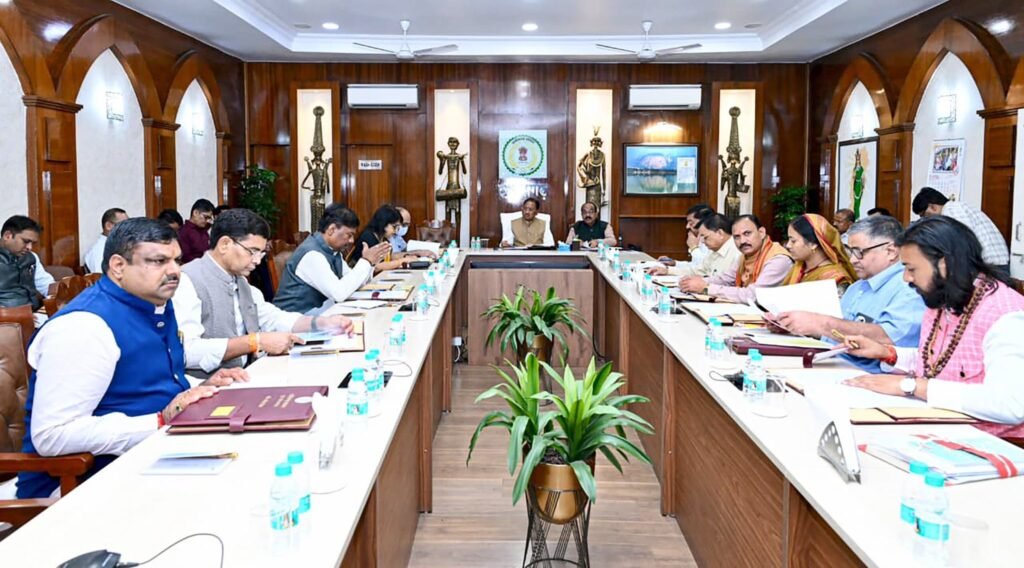
Chief Minister Vishnu Deo Sai presides over a meeting of the Chhattisgarh Council of Ministers on Sunday, October 11, 2026, at 12 noon at the Chief Minister’s Residence Office in Civil Lines, Raipur , where decisions concerning tribal administration and former Agniveer recruitment were approved. The Cabinet also adopted a congratulatory resolution marking Prime Minister Narendra Modi’s 25 years in executive leadership.Photo:channel24india.com via CG/CMO
The Cabinet approved a proposal to amend the Chhattisgarh Government Business (Allocation) Rules to change the department’s name from Adim Jati Vikas Vibhag to Janjatiya Karya Vibhag.
In English, the change can be described as renaming the Tribal Development Department as the Tribal Affairs Department.
The decision represents a change in official administrative nomenclature and is expected to be reflected in government rules, correspondence and departmental records following the required formalities.
The Ministry of Tribal Affairs already functions at the Union government level, and the proposed state nomenclature follows a similar institutional approach.
The terminology also places emphasis on tribal affairs as a wider field of public administration, encompassing welfare, development, rights, educational opportunities and the implementation of relevant government programmes.
However, the Cabinet announcement does not specify any immediate change to the department’s budget, existing schemes, staffing structure or statutory responsibilities.
Those aspects will depend on any subsequent government orders and administrative notifications.
Administrative Identity and Tribal Development
Chhattisgarh has a substantial tribal population, making the functioning of the department responsible for tribal affairs particularly important.
Government programmes in tribal regions cover a wide range of concerns, including education, healthcare, livelihood opportunities, infrastructure and access to essential public services.
The renaming decision offers an opportunity to examine how administrative institutions can respond more effectively to the requirements of communities living in remote and underserved regions.
A change in departmental name alone does not automatically alter service delivery.
Its practical significance will depend on the quality of implementation, the effectiveness of existing programmes and the responsiveness of the administration to the communities it serves.
For tribal families, the meaningful measure of governance will continue to be access to schools, healthcare facilities, livelihood support and the timely delivery of welfare benefits.
Former Agniveers to Get Recruitment Opportunity in State Police
The Cabinet also approved recruitment of former Agniveers against 36 vacant constable posts in the Home Department.
The decision creates an employment opportunity for individuals who have completed their service under the Agnipath recruitment scheme.
Former Agniveers have undergone military training and acquired experience in discipline, physical fitness and organised service environments.
These attributes may be relevant to policing duties, although police work also requires specific training in criminal law, investigation procedures, public interaction and the protection of constitutional rights.
The Cabinet decision does not specify the detailed eligibility conditions, selection procedure, age relaxation, reservation provisions or recruitment timetable.
Those requirements will need to be clarified through the applicable recruitment rules and subsequent official notifications.
Reintegration of Trained Youth into Civilian Service
The recruitment decision has wider significance in the context of employment opportunities for young people leaving short-term military service.
Former Agniveers may seek careers in public administration, security services, private industry and other fields after completing their period of service.
The availability of posts in the state police can provide one route for the continued use of their training and experience.
At the same time, transparent recruitment procedures will be important to ensure that appointments comply with applicable service rules.
The immediate Cabinet approval concerns 36 vacant posts and should not be interpreted as a broader recruitment announcement beyond that number.
Cabinet Reviews Preparations for President Murmu’s Chhattisgarh Visit
The Council of Ministers also discussed preparations for the forthcoming visit of President Droupadi Murmu to Chhattisgarh.
A presidential visit requires coordination among several government departments and agencies, including those responsible for protocol, security, transport and arrangements at official venues.
The Cabinet’s discussion placed emphasis on administrative readiness and coordination between the departments concerned.
The detailed itinerary, specific programmes and venues were not provided in the Cabinet account.
These particulars will become clear when the President’s official programme is announced.
The visit is expected to be an important occasion for the state administration, requiring careful planning to ensure that official engagements proceed smoothly.
Cabinet Congratulates Modi on 25 Years in Executive Leadership
The Cabinet adopted a congratulatory resolution marking Prime Minister Narendra Modi’s completion of 25 years as a head of government.
The resolution recognised his period of leadership at the state and national levels and referred to development initiatives undertaken during that time.
Modi first became Chief Minister of Gujarat in October 2001 and subsequently assumed office as Prime Minister of India in May 2014.
The Cabinet’s resolution highlighted central government schemes and initiatives that the Chhattisgarh government considers important for the state’s development.
These included programmes relating to housing, food security, healthcare, farmers’ welfare and women’s empowerment.
The resolution also referred to infrastructure development, investment proposals and central support for projects in sectors such as roads, railways and electricity.
Central Support and Chhattisgarh’s Development Priorities
The state government’s resolution placed particular emphasis on the relationship between national development programmes and their implementation in Chhattisgarh.
Housing assistance, public distribution of foodgrains, healthcare programmes and support for agricultural households remain important components of welfare delivery.
Infrastructure projects, meanwhile, can influence connectivity, industrial investment and economic opportunities.
The Cabinet referred to these areas while acknowledging the contribution of Union government initiatives to the state’s development agenda.
The announcement did not provide a consolidated, independently verifiable financial statement of the resources or investment amounts referenced in the resolution.
Accordingly, no additional financial figures have been attributed to the Cabinet beyond those contained in the supplied account.
Viksit Chhattisgarh as a Contributor to Viksit Bharat 2047
The Council of Ministers also reiterated its commitment to the vision of Viksit Bharat 2047, the national objective of building a developed India by the centenary of Independence.
The Cabinet affirmed that the development of Chhattisgarh would form part of the country’s broader progress towards that goal.
For the state, long-term development will involve improving public services, expanding infrastructure, strengthening education and healthcare, supporting agriculture and encouraging sustainable economic activity.
The effectiveness of this vision will depend on measurable improvements in citizens’ living conditions and the creation of durable economic opportunities.
CM Sai’s Leadership and the Cabinet’s Governance Agenda
The Cabinet decisions were taken under Chief Minister Vishnu Deo Sai’s leadership and reflect several priorities of his administration.
The renaming of the tribal department concerns administrative identity and governance structures. The recruitment decision addresses employment opportunities for former military personnel. Preparations for the President’s visit involve constitutional protocol, while the resolutions concerning national leadership and Viksit Bharat 2047 reflect the government’s wider political and developmental outlook.
Taken together, the decisions illustrate the different responsibilities undertaken by the Council of Ministers, ranging from specific personnel matters to long-term policy direction.
The next stage will be the issuance of formal notifications and the implementation of the decisions through the departments concerned.
‘Nation First and Good Governance’: CM Sai Hails Modi’s Leadership
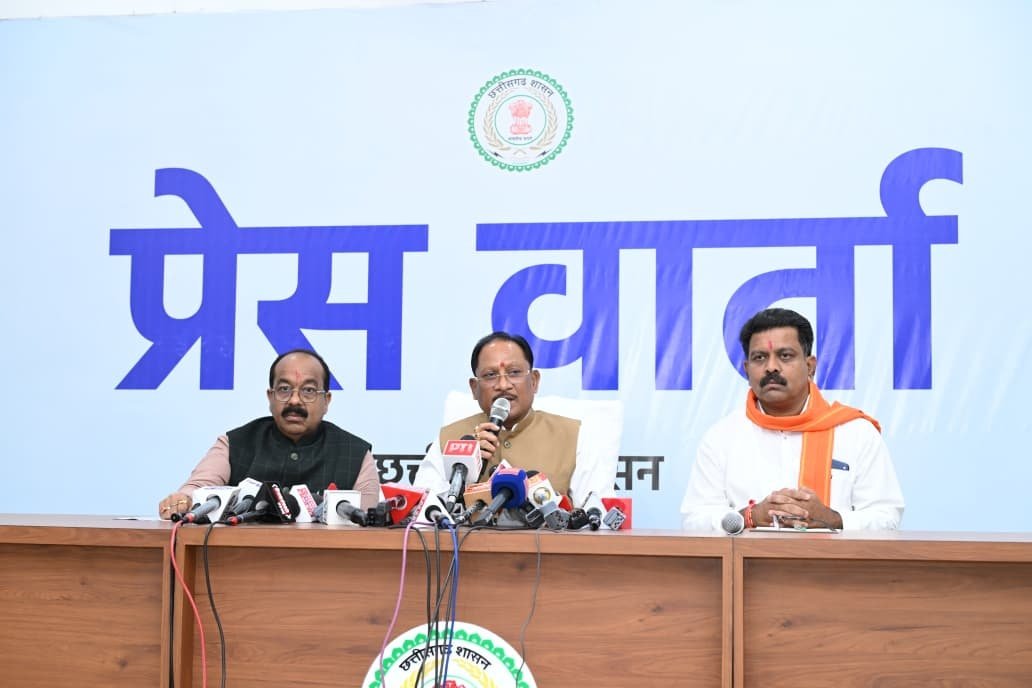
Following the Cabinet meeting, Chief Minister Vishnu Deo Sai addressed the media and described Prime Minister Modi’s completion of 25 years in executive leadership as a historic milestone.
“It is a historic milestone in an extraordinary journey guided by the principles of nation first, public service, good governance, welfare of the poor and upliftment of the last person,” Sai said.
He expressed gratitude to the Union government for supporting Chhattisgarh through cooperative federalism and helping extend housing, drinking water, sanitation, food security, healthcare and clean cooking fuel to disadvantaged households.
Referring to the state’s early development experience, Sai said:
“Chhattisgarh, which was formed in 2000, also learnt from successful experiences of the Gujarat model during its initial years of development and made rapid progress.”
The Chief Minister also presented figures illustrating the state’s progress under centrally supported programmes.
According to Sai, 20.65 lakh rural houses and 2.25 lakh urban houses have been completed under the Pradhan Mantri Awas Yojana. He stated that 11.78 lakh houses were constructed during the preceding three years.
He further reported that 26.57 lakh farmers in Chhattisgarh had benefited directly from PM-Kisan Samman Nidhi.
On fiscal support, the Chief Minister said the state’s share of central taxes had increased substantially over successive periods, citing ₹3,46,806 crore received during the preceding 12 years, compared with ₹47,100 crore during 2004–2014. These figures were presented as part of the government’s assessment of central support.
Chief Minister Emphasises Tribal Welfare, Employment and Development
Sai also highlighted government initiatives intended to improve living conditions in tribal regions, including programmes for housing, connectivity, drinking water and essential public services.
He referred to the expansion of infrastructure in Bastar and the importance of strengthening education, healthcare and communications in previously underserved areas.
The Chief Minister linked these development priorities with the broader vision of Viksit Chhattisgarh and Viksit Bharat 2047.
His remarks placed particular emphasis on using the state’s natural resources, agricultural strength, young workforce and tribal heritage as foundations for future progress.
Implementation Will Determine the Impact of Cabinet Decisions
The Cabinet’s approval of the departmental name change will require the corresponding amendment to the Government Business (Allocation) Rules.
Similarly, the recruitment of former Agniveers against 36 constable vacancies will have to proceed in accordance with the applicable recruitment framework. The state has already provided for 10 per cent category-wise reservation for former Agniveers in the relevant posts.
For the state administration, the immediate priorities will include completing the necessary procedural formalities and ensuring that the decisions are implemented transparently.
The Sai Cabinet’s latest meeting has thus combined administrative reform, employment opportunities for former Agniveers and a renewed declaration of its development priorities, while the Chief Minister has reaffirmed his government’s commitment to advancing Chhattisgarh’s progress through cooperation with the Union government.