Kumar Bahukhandi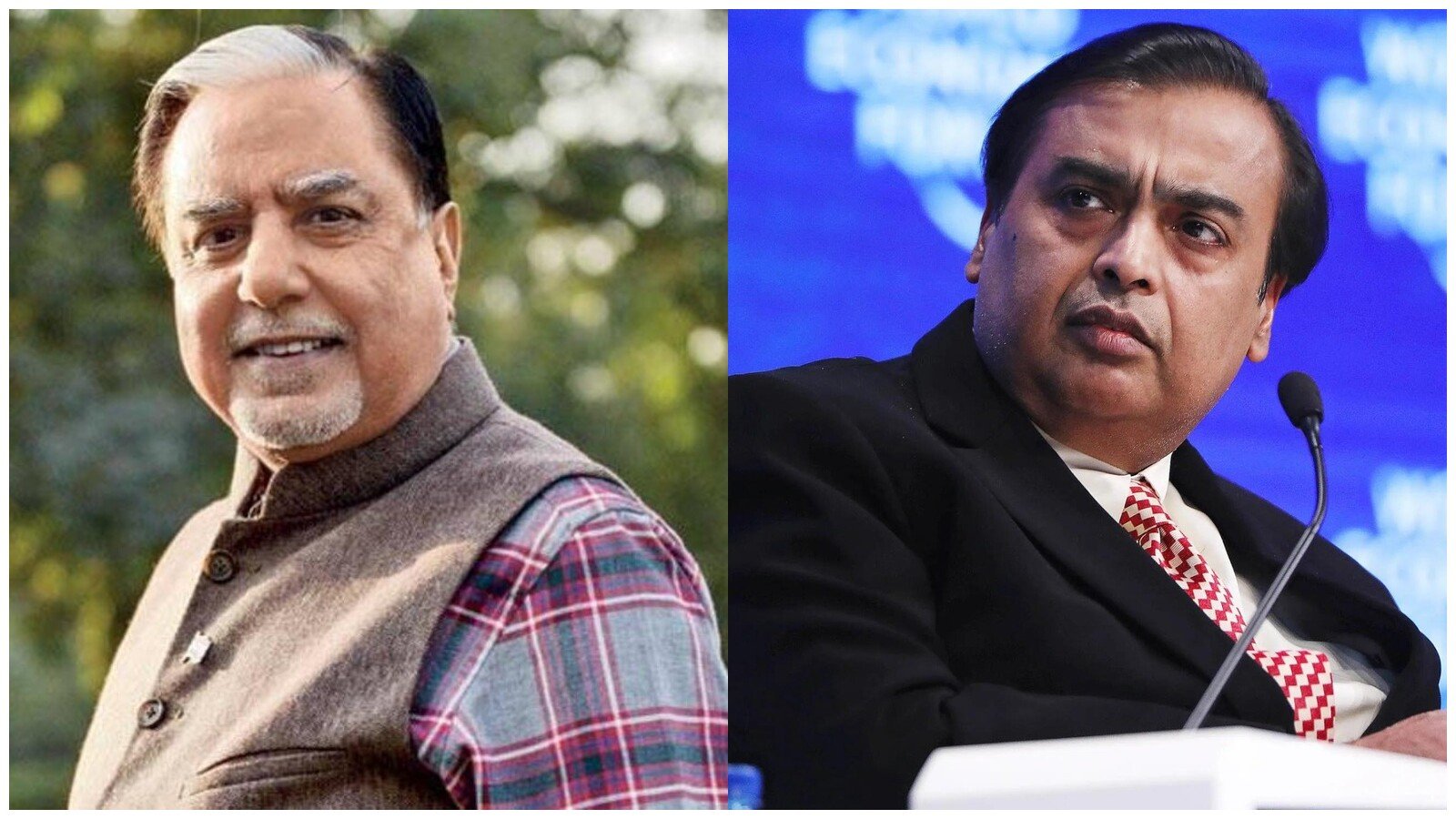
Zee founder Subhash Chandra (left) and Reliance Industries chairman Mukesh Ambani are at the centre of a public confrontation that has renewed questions about corporate ownership and editorial independence in Indian media. Reliance has categorically denied Chandra’s allegations-Photo Credit:Photo composite: Prime Look; source photographs: Subhash Chandra Foundation and World Economic Forum via Wikimedia Commons/CC BY-SA
The public confrontation between Subhash Chandra and Mukesh Ambani raises questions extending far beyond corporate debt: can audiences trust news organisations when their owners become parties to the story?
The war of words between Zee founder Subhash Chandra and Reliance Industries chairman Mukesh Ambani is not merely another quarrel between two influential businessmen. It places an uncomfortable question before Indian journalism: what happens when those controlling major news organisations use their own platforms while fighting corporate and personal battles?
Chandra has accused media entities associated with Reliance of spreading what he calls a misleading account of the National Company Law Tribunal proceedings concerning his financial liabilities. Reliance has categorically rejected the allegations, maintaining that its media brands have never been used to attack anyone.
Neither accusation nor denial, by itself, establishes the truth. That must be determined through documents, tribunal orders, independently verifiable financial records and, where necessary, appellate proceedings—not through the volume or reach of competing television networks.
At the centre of the controversy is the widely circulated assertion that liabilities of approximately ₹22,000 crore were settled for merely ₹6.5 crore. It is an irresistible headline: simple, shocking and almost guaranteed to provoke public anger.
But simplicity can become distortion when essential legal distinctions are removed. The ₹22,000-crore figure concerns admitted creditor claims in personal-insolvency proceedings involving Chandra as a guarantor for debts raised by Essel-linked companies. The amount recoverable from him personally under the approved resolution plan is a separate question from the obligations and assets of the borrowing companies.
This does not mean that the tribunal-approved recovery should escape scrutiny. A settlement producing an exceptionally small recovery against enormous admitted claims naturally raises legitimate questions. Creditors are entitled to challenge it, financial journalists must investigate it and the public has every right to understand how such an outcome became legally possible.
However, responsible reporting must explain whether an amount represents a personal loan, a corporate borrowing, a guarantee, an admitted claim or an actual recoverable liability. Combining all these categories into one dramatic television line may attract audiences, but it does not necessarily illuminate the case.
Chandra says companies and family members associated with his group have repaid approximately ₹43,000 crore out of liabilities that once stood at about ₹45,000 crore, largely through asset sales. This is his account and must be independently examined rather than automatically accepted or dismissed.
His broader allegations against Ambani—including claims concerning Zee’s share price, a proposed acquisition and the conduct of Reliance-linked media—are serious. Yet serious allegations require serious evidence. References to supposed corporate conspiracies, hidden companies or “skeletons in the cupboard” cannot substitute for documents placed before regulators, courts or the public.
Indeed, Chandra weakens his own argument when a demand for accurate reporting turns into a personal warning. If he possesses evidence of market manipulation, unlawful corporate conduct or misuse of media power, the appropriate course is to submit it to the relevant statutory authorities and disclose whatever can lawfully be placed in the public domain.
Reliance’s denial must also be reported fully and fairly. The group has described Chandra’s remarks as baseless and rejected the suggestion that its media organisations were used to target him. It has also said that it holds Chandra in high regard as an entrepreneur.
That denial is important, but the larger ethical question does not disappear with a corporate statement. Media companies owned or controlled by diversified business groups carry a special responsibility when reporting on competitors, regulators, lenders or disputes affecting their proprietors.
Ownership Must Not Become Editorial Command
India’s media landscape is increasingly shaped by large corporate groups whose commercial interests extend far beyond journalism. Such ownership is not automatically improper. Newspapers and television networks have always required capital, infrastructure and managerial support.
The danger arises when viewers cannot distinguish independent editorial judgement from the strategic interests of an owner.
Zee News was the platform through which Chandra presented his case before what he called the “people’s court”. Reliance-associated media outlets are themselves central to his accusations. This creates an extraordinary situation in which media organisations are not merely reporting a dispute; they risk becoming participants in it.
A newsroom should never become its proprietor’s private courtroom. Nor should its microphones become weapons in an industrial rivalry.
If a channel reports on a matter directly affecting its owner, it should disclose that relationship prominently. It should publish the relevant tribunal order, explain the disputed figures, invite independent legal and financial experts, and give the opposing party a meaningful opportunity to respond.
The same standard must apply to Zee, Network18, CNBC-TV18 and every other news organisation owned by a large commercial group. Editorial independence cannot be demanded only when one’s own interests are under attack.
The controversy also demonstrates why complex legal and financial proceedings should not be reduced to slogans. “₹22,000 crore settled for ₹6.5 crore” conveys outrage but not necessarily understanding. “All reporting is propaganda,” on the other hand, dismisses legitimate scrutiny without answering the underlying questions.
Between these two extremes lies journalism: patient examination of documents, precise use of terminology, separation of allegation from fact and willingness to correct an incomplete account.
The public does not need to choose between Subhash Chandra and Mukesh Ambani. It needs credible information about the tribunal’s reasoning, the nature of the guarantees, the position of dissenting creditors, the assets available for recovery and the legal remedies that remain open.
Both businessmen possess resources and platforms capable of making their respective versions heard across the country. Ordinary citizens possess no comparable megaphone. Their only protection is a media system that values evidence more than ownership, and accuracy more than corporate loyalty.
This confrontation may eventually be settled in tribunals, regulatory proceedings or private negotiations. The damage to public trust in journalism will be harder to repair if media platforms are perceived as extensions of their owners’ business strategies.
The real test is therefore not which billionaire wins the argument. It is whether the news organisations associated with them can report the dispute without surrendering their credibility.